Kenny Brown Chassis Reinforcement
The chassis is always the place to begin when making platform
modifications. Take care
of chassis reinforcement first. Before changing the suspension and before adding
significant power. If you reinforce
the unibody first to create a rigid structure prior to moving on to other areas, you won't
risk chassis fatigue when stiffening the suspension, and you won't twist
the unibody by applying too much torque to a stock platform. You'll also avoid being later surprised
that your suspension tweaks no longer work so well after you finally get
around to reinforcing your vehicle's structure because you postponed the chassis
work too long. Your vehicle's suspension needs will change as its chassis
dynamics are upgraded, so you could very well end up unnecessarily repeating
some suspension modifications if you don't proceed in the correct order.
With this in mind, I began investigating available chassis upgrades
soon after I bought Taz. Any convertible based on a coupe platform is prone to chassis
flex and cowl shake. Taz wasn't as bad as some old tin I've driven, but he was still
somewhat of a flexi-flyer over broken and
uneven pavement. Many have lamented the fact that all Mustangs from the Fox
bodies through the Terminators were based on the underpinnings for the old
Fairmont. Personally, I have never considered this such a terrible shortcoming.
But then, I
suppose I am one of a very few who still remember that the automotive press
acclaimed the Fairmont's rigid structure when it debuted, labeling the car the
"American Volvo." Indeed, the "lowly" Fairmont chassis was never considered
lowly at all, and the numerous tweaks that have been applied to the design over the years have
further strengthened the platform. Nevertheless, it was obvious that there was still room for
improvement, particularly with respect to the convertibles, since the Fairmont platform hadn't
been designed with a ragtop model in mind.
After considerable research, I settled on chassis components from
Kenny Brown. I opted for the full
Extreme
Matrix chassis reinforcement system, which stiffens the SN95 unibody structure by adding a
"mini-frame" of box-section and tubular steel, rather than by simply reinforcing the floorpan
longitudinally, as standard subframe connectors do. Unlike ordinary SFC's, even those constructed with seat
brackets, the Extreme Matrix vastly improves the chassis' torsional rigidity in addition to reinforcing
the unibody against longitudinal flexing. This helps to minimize the car's yaw tendencies, which cannot be
addressed with standard SFC's.
The advantage of adding lateral, as well as longitudinal, reinforcement
can be demonstrated by computer simulation, and using CAD/CAE software from AutoDesk, I confirmed that adding the Kenny
Brown Extreme Matrix to Taz's chassis would result in a 132% percent improvement in
chassis torsional rigidity, whereas SFC's alone would provide essentially no increase in
torsional resistance. Obviously, a matrix system would be less crucial for a coupe, because
its roof shell moderates its torsional deformation to a large extent. But a convertible's
platform cannot be adequately stabilized without some sort of matrix reinforcement.
Editorial Comment:
Why not a through-the-floor chassis reinforcement system? Well, because
Taz is a STREET CAR, not a dedicated track car. Furthermore, if I had wanted a 2-seater, I'd
have bought one to begin with. I wasn't interested in compromising the Cobra's ability to carry
rear passengers or in making the front seat area a less hospitable place to be. While there are a
few for whom these considerations are irrelevant, I believe the vast majority of folks will
agree with me on this one.
I had the Extreme Matrix components welded in by my regular body
and frame shop, and I stayed at the shop with the car until the chassis tech had finished
his work, so I can assure you this is a full 6-hour job when done right, even
for an experienced technician. Naturally, I neglected to shoot any pics of the
installation in progress, but here is a Kenny Brown stock photo of the
Extreme Matrix to provide a visual of the system's components.
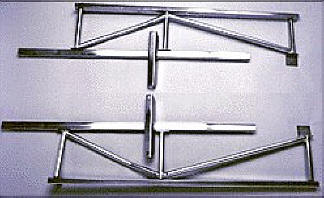
Although the installation of this framework effectively negated the weight savings that I
had accomplished by swapping to lightweight BBS wheels, this weight was at
least confined to an area where it would impose the least negative impact. In
fact, the Kenny Brown pieces even help to lower the car's center of gravity
just a little.
NOTE: In
2005, Kenny Brown Performance, a leader in Mustang chassis and suspension
technology, temporarily ceased operations as a business entity after the
company's namesake fell seriously ill. That's the bad news. The good news is
that Kenny has fought his way back along a bumpy road to recovery, and KBP
products are once again available in the marketplace. A limited KBP product
selection can be found at the company's online store, as well as at a few select
vendors.
Editorial Comment:
There's an old adage that advises you can work harder or
you can work smarter, but the two are not the same. The chassis reinforcement
corollary to this adage is that you can stiffen a platform intelligently or you
can just keep throwing material at it until you achieve the rigidity you want. Knuckle
draggers invariably subscribe to the latter approach. These misguided souls refuse to even
consider the notion that anything as light as the Kenny Brown Extreme
Matrix system (about 40 lbs total) might be as effective as competing
products weighing much more. They contend that the Extreme
Matrix can't possibly do a proper job of shoring up the SN95 chassis because it
just isn't massive enough. This is not at all surprising, considering the majority of these
individuals aren't capable of even spelling finite element analysis, much less
grasping the concept.
OEM Convertible K-member Brace
All New Edge Cobra drop-tops left the factory equipped with bolt-on
front K-member braces to minimize cowl shake. Unfortunately, while hot-footing it
along a dark and twisty canyon road one night, I ran up over a fair sized chunk of
granite that had tumbled into the middle of the road during a rock slide and bent
Taz's brace. Luckily, the rock damaged only the brace, and the damage appeared
entirely superficial, but it still bothered me, so I replaced the part with a new
one while I had the car in the air for Taz's 6-speed transmission installation.
Below, you can see both the damaged original part and the replacement.
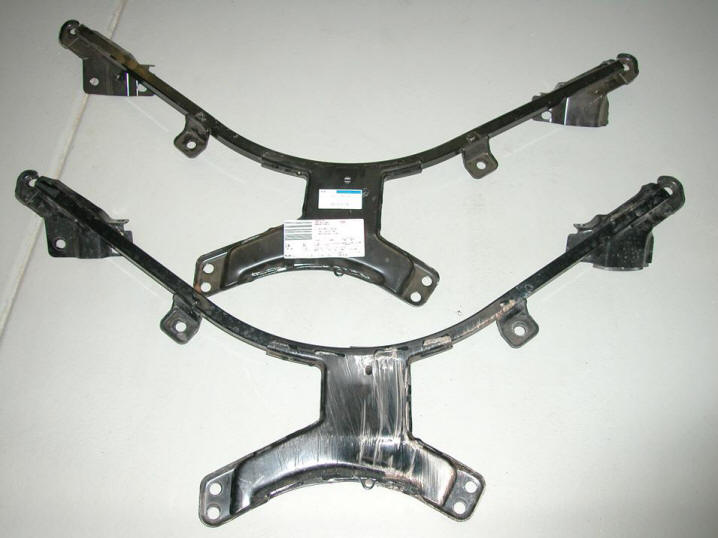
My thanks to Ford for adding this part to all ragtop Cobras. Not
only does it work well at keeping cowl shake in check, but it's entirely possible the brace
saved my motor that night. The large dented and scraped area that you see on the original
part had been located directly below the oil pan, so the brace took the hit in lieu of the
pan, itself. If the brace hadn't been there, the evening might have ended very differently
and most unhappily for me. Holing an oil pan on a desolate canyon road in the middle of the
night doesn't appear anywhere on my "must-do" list.
Editorial Comment:
Replacing the factory K-member of a New Edge ragtop with one of the
various aftermarket offerings would also require disposing of this brace. It appears to me
that if you do this, you'll be shooting yourself in the foot from a handling standpoint if
you are a corner carver. Just a little something to think about before you start "improving"
things in that area.
I realize that replacing one part with another identical part certainly
doesn't qualify as any sort of upgrade, but I thought I'd give the coupe owners a peek
at this convertible-specific part. A couple of my friends have asked if I thought they
could install these braces on their coupes. The answer to that question is that all things
are possible, but I think retrofitting one of these to a New Edge coupe might require a
disproportionate amount of time and effort. The coupes aren't equipped with the necessary
attachment points. Many of the dozen or so bolts that secure this piece are threaded into
proprietary weldments in the ragtop's unibody structure.
NOTE:
The above part is a BRACE. I've seen various Internet ignoramuses from time to time attacking
this part as - in their opinions - an inferior factory subframe connector because it bolts on.
First, it isn't a subframe connector at all. It's a K-member brace designed specifically to
reduce cowl shake on the ragtops. That's why it wasn't supplied on the coupes. Second, ALL
K-member braces bolt on, because they must be removable. Third, this part isn't inferior at
all. It's beefier than any of the aftermarket braces I've seen, and is secured by no less
than 13 bolts vs. two or four for most aftermarket pieces.
Suspension Upgrades, Round 1

One automotive modification invariably begs another, doesn't it? In my case, as soon as
the Cobra's chassis reinforcement was installed, the car began to feel under-damped and under-sprung. The
stock suspension components simply weren't up to the task of properly controlling the vehicle's ride motions
once the chassis flexing had been minimized, so I immediately began looking into suspension upgrades. I
didn't want to take Taz too far into the realm of hardcore handling, since he was primarily a street-driven
fun machine. Having heard many complaints such as, "I expected a rougher
ride after the install but right now I don't even want to drive it" (an actual quote from
a member of one of the Internet's Mustang forums), I was mindful of avoiding the introduction of undue ride
harshness with respect to the car's suspension upgrades. Just a few minor tweaks to sharpen its reflexes.
And since the stock suspension's ride height gave the car a bizarre 4WD appearance, I decided to lower it
a bit, as well as address its handling.
After considering my options, I settled on a set of Sport Springs from the German
manufacturer H&R. All performance springs
will lower a car to some extent, and the H&R's provided a moderate 1.5" drop all the way
around. I would have preferred less drop, but all the springs available at the time that offered less were
either a bit too stiff for my preference (e.g. '00 Cobra R springs) or a little too soft (e.g. the Steeda
Sport springs).
The H&R Sport Springs are progressive up front (700 - 760 lbs/in) and linear out back at 685 lbs/in,
which made for a decent ride on less than perfect public roads. Although these rates are stiffer than those of the
car's stock springs, which had been 500 lb/in in front and 470 in the rear, the progressive fronts did a great job
of mitigating the increased bump harshness. (All four of the OEM Cobra springs had been linear rate.)
Editorial Comment:
Why not shoot for a bigger drop? Well, from a performance standpoint, there are multiple
reasons to avoid lowering an SN95 Mustang more than installing a set of H&R's will accomplish. Lowering a
car too much ruins its handling ability, destroys its steering response, and subjects its undercarriage and exhaust
components to terminal road rash. Why would anyone want to alter a performance car in such a way that that it would
henceforth need to be eased around like Granny's LTD? Why not just buy an LTD in the first place and slam that, so
real car guys wouldn't want to rip your lungs out? And let's not even consider the possibility of removing all of
the vehicle's spring isolators to achieve an even more exaggerated drop, because that represents a level of stupidity
beyond words. Furthermore, from a purely visual perspective, any car lowered beyond a certain point looks completely
ridiculous.
Let's face it. Slamming a vehicle is just plain ignorant from any
standpoint, and anybody who does so merely to make his ride look "dope" is a moron who should be
sterilized in an effort to help clean up the gene pool. Yo! Home Boy! A vehicle is a dynamic entity. As such, its
intrinsic value is grounded primarily in how well it goes, turns, and stops. Modifications performed to any vehicle
that undermine those dynamic capabilities are simply retarded, regardless of the motivation. With all things
automotive, form follows FUNCTION! Besides, when your car's undercarriage is banging and scraping all over the
pavement, it doesn't look dope, just DOPEY - and so do you.
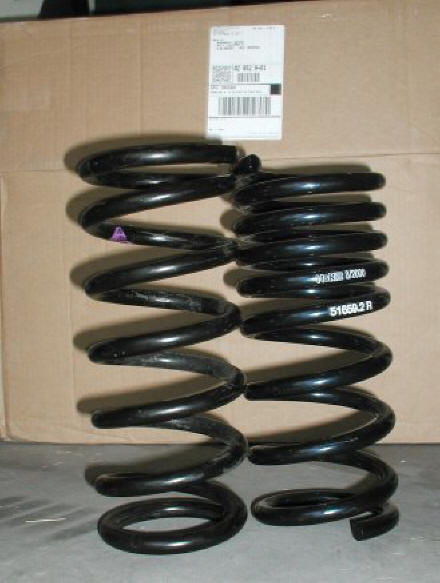
Because the rear H&R springs are wound with a number of
"dead" coils at their tops, many mistakenly believe that they are progressive, just
like the fronts. This is not so. Once the suspension is loaded, the dead coils
all collapse together, so they do not contribute to the springs' operation.
Below is a photo of a stock rear spring next to its H&R counterpart :
NOTE: A few years after installing
the H&R's, I became a road course junkie. This resulted in my eventually swapping out my Sport
Springs for a set of Engineered Performance (a.k.a. Kenny Brown Performance) springs
in a quest to move Taz toward more track-oriented handling. Refer to the section below detailing the
Cobra's 2006 - 2007 suspension modifications for comments regarding the swap.
Editorial Comment:
Have you been toying with the notion of going the economy route and
lowering your car by simply cutting your stock springs? Want to show a glimmer of intelligence by learning
from someone else's mistake for a change? Here is what one intrepid soul had to say about his
own results after cutting his factory springs:
"I cut 1 coil all the way around and this POS
drags everywhere. Plus it handles like ass. It was much better before. Cutting springs is a cheap
but wrong way to do a suspension. I will be changing mine in the near future. That's how much I
dislike it!!!"
Yes, that was a real assessment by an individual who
already made the mistake you may be considering. I don't invent these comments. I don't need to.
However, if risking the possibility of ending up the way that guy did just to save a few bucks when
lowering your car still sounds like the hot ticket to you, then have at it. I'm sure you'll get
exactly what you deserve.
For optimum performance, a vehicle's dampers must be matched to its
springs, so I replaced the stock units when I installed the H&R spring set.
I opted for Bilstein
shocks and struts valved to match the new spring rates. The Bilstein shocks
best matching the jounce and rebound characteristics of the rear Sport Springs
turned out to be the same shocks used on the 2000 Cobra R, and the struts that most
closely matched my new front springs were available at the time as P/N V36-4138-H1.
However, Bilstein revised its lineup shortly afterward, eliminating this strut
in the process and opening gaps in its product range. These gaps were later filled
during a subsequent revision, and struts comparable to mine were again made available as P/N
35-045939. Also, I do not believe the 2000
Cobra R shocks are available any longer. The closest substitute for those in the
current Bilstein lineup would be P/N
24-185974 (previously # F4-BE5-C265-H0).
As every owner of an SN95 Mustang knows - or should know - the factory strut
plates are marginal with regard to adjustability, even with the stock suspension geometry, and
their off-center 3-point attachment isn't as stout as it could be. Good caster/camber plates
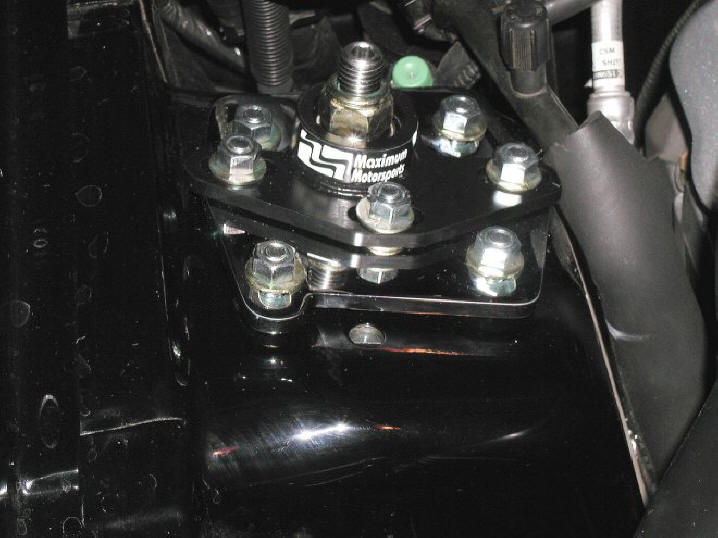
were definitely in order. The
Maximum Motorsports C/C plates had been the de facto standard for some time when I went
looking for a set for Taz, and who was I to argue with success? The addition of a 4th baseplate
mounting stud to more evenly distribute the load on the strut tower meant drilling another hole
in each tower, but a man's got to do what a man's got to do. Below, you can see the new passenger
side C/C plate installed on the right strut tower:
Because these C/C plates employ Heim joints to locate the strut
shafts, they improve the car's directional stability at the price of a little
more NVH transmitted up into the chassis. Some individuals on the various
automotive forums will attempt to convince you that this is not true, and that
this design doesn't increase NVH at all. Do NOT believe them! Even
Maximum Motorsports will admit otherwise, as evidenced by the following
quote, which I lifted directly from the MM FAQ page for this product:
"The Caster/Camber plates themselves do not cause any
noise. However, they can transmit other suspension noises more easily than the
rubber factory strut mount. There may be a slight increase in road noise from
the tires, and slightly increased noise from the brakes. A slight increase in
harshness when encountering abrupt bumps may be noted."
While it is true that the NVH increase is slight, the increase
is discernable to those who are sensitive to such things. If you are
such a person, as I am, you will hear and feel the difference. I
have personally been willing to accept this minor NVH increase in order to
achieve more precise handling, but everyone is different, so you must decide for
yourself if this tradeoff will be acceptable to you. There are other C/C plates
available that provide the adjustability of the MM plates without introducing
more NVH, but they will not sharpen your car's handling. The choice is yours.
One of my axioms is that all things automotive involve tradeoffs. You'll see
this motto cited again and again throughout this site. Believe it. No truer
words were ever spoken with regard to our personal conveyances.
Reducing a vehicle's ride height without shortening the end links
attached to its sway bars will position the bars at an angle and introduce an unwanted
preload, compromising handling performance. To avoid this, I picked up a set of
19-408-BL
end links from Maximum Motorsports and installed them with the springs
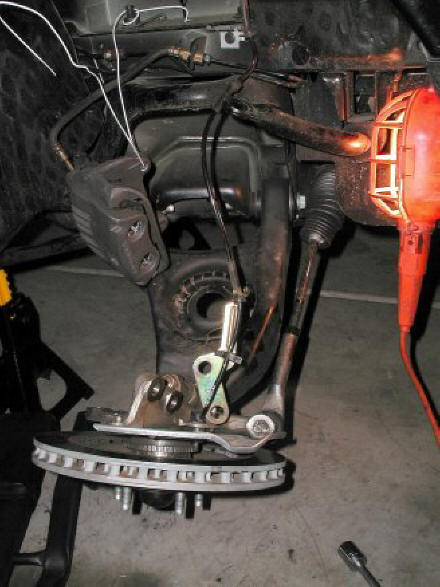
and struts, while I had the front suspension disassembled. Here's a shot of the passenger
side front with the OEM strut, spring, and end link removed:
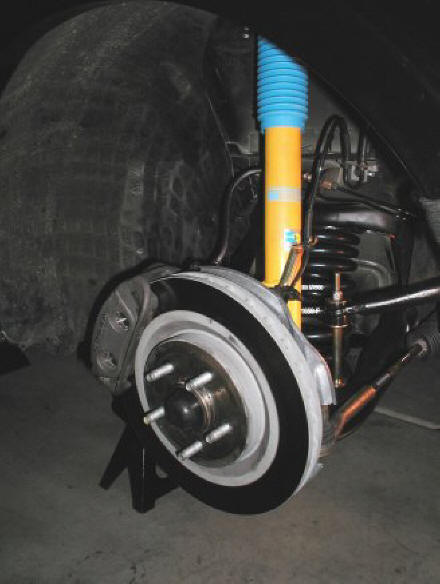
This is the same corner with the new suspension
components installed.
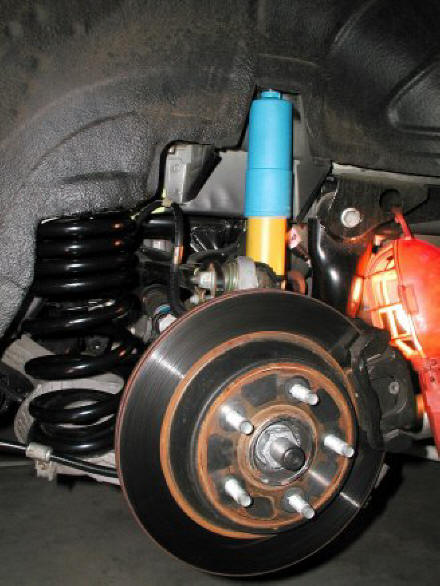
And here's a photo of the left rear after I had finished swapping out
the shock and spring at that corner. At the time, shorter sway bar end links weren't yet
available for the IRS, so I left the OEM end links in place. Maximum Motorsports
later released some very nice adjustable rear sway bar end links, which made the line-up
for round two of the car's suspension upgrades, but that was years after this photo was
taken.
My initial round of suspension upgrades turned out well, but it had been
less than a barrel of laughs to accomplish, primarily because replacing the OEM springs
with the new ones had been a major PITA. During the swap, I had springs twice jump out
and try to separate my head from my shoulders. Fortunately, the springs had been tethered
with safety ropes, which stopped their progress short each time.
Since then, I've learned quite a few new tricks, and if I knew then what I know now, that
initial suspension project would certainly have gone much more quickly and enjoyably. In fact,
I've completely removed and reinstalled both the front and rear suspensions since then - more
than once - with far less drama. Regardless, I recorded some detailed notes during Taz's 2002
round of suspension upgrades, which may be of interest to some. The link below will take you
to a copy of those notes.
2002 suspension
upgrade notes (PDF)
Suspension Upgrades, Round 2
In 2005, I developed a distinct fondness for open track events,
so I decided to further sharpen the Cobra's handling dynamics, this time with a
stronger emphasis on track performance. I wasn't shooting for the kind of
dedicated racecar dynamics that would brutalize me on bombed out public streets,
just a few meaningful tweaks that would enable me to push the envelope a little
harder when out on the road course. By the end of 2006, after accumulating
various new components over an 18-month period, I finally had all the parts I needed,
so I reserved some time to install them, along
with all the drivetrain goodies I had also been collecting. Due to my limited
free time, installation of all the new parts ran from the beginning of December,
2006 until mid-February, 2007. The poor Cobra was perched on jack stands the entire
time, but when he finally came back down off the stands, Taz had been once again
transformed.
NOTE: For those interested
in a few suspension tuning guidelines, as well as some general technical information
about suspensions, I have added a Handling Tweaks section to this site's
Tech Docs
page.
This round of suspension work included installing fresh
Maximum Motorsports
sway bar end links at both ends of the car (adjustable links in the rear) and swapping out all the
remaining rubber chassis and suspension bushings with poly replacements, except for
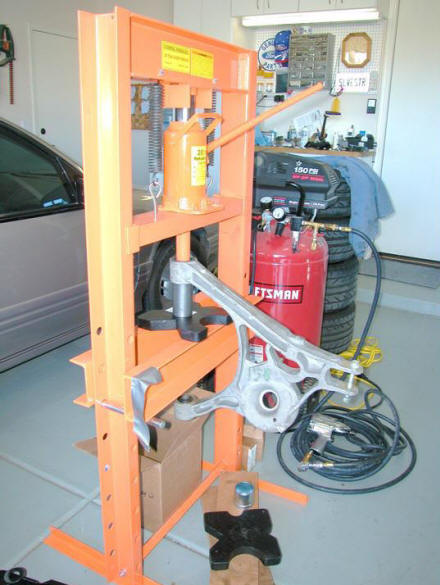
the front control arms (more about those below). In the following photo, you can see one of the OEM bushings
being pressed out of the right rear LCA.
NOTE:
For those seeking a surefire solution to the IRS Cobra's
wheel hop during hard launches, I have published the elusive SILVER BULLET
HERE on the Tech
Docs page of this site . You owe it to yourself to give it a read if wheel hop
is an issue for you.
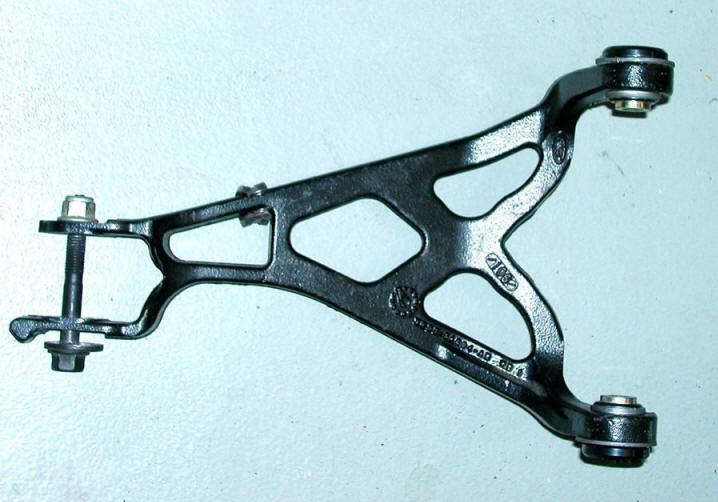
And this photo shows Taz's left rear UCA ready to be
reinstalled on the car after its bushing upgrade had been completed.
TECH TIP: When
installing polyurethane suspension bushings, create a lubricating paste consisting of
25% Permatex
Anti-Seize
and 75% of the synthetic grease supplied with your bushings. Then, apply this paste inside each bushing and
around the outside of its metal crush tube prior to installation. This will provide you with long-lasting
lubrication and a noise-free installation. Do NOT apply this paste to the insides of your bushing shells or
around the outer circumferences of your bushings. Poly bushings weren't designed to rotate within
their shells, and inducing them to do so will shorten their service lives.
Each bushing should rotate around its crush tube. That is the only articulation
you want or need for a proper installation.
Although every "soft part" is considered a wear
item, a good set of properly installed poly bushings will give you many years of
silent, trouble-free service. All of my own poly bushings are still like new and
perfectly quiet after several years of hard use.
Let's take a moment to consider the available suspension bushing options. As with everything else
automotive, one's bushing choices involve tradeoffs. Invariably, the level of
NVH (Noise-Vibration-Harshness) within the cabin will increase with bushing stiffness.
That's just how it is, and only an imbecile would attempt to convince you
otherwise. Rubber bushings, being the most compliant, will
transmit the least NVH, and metal bushings, a.k.a. hard mounts, will transmit the
most, with the NVH transmissions of other materials, such as polyurethane and
Delrin, lying at various points between those two extremes.
Ford OEM bushings are rubber because
Ford places a premium on reducing NVH in order to give its vehicles the broadest market
appeal. However, maximizing isolation exacts certain performance penalties, so
many enthusiasts replace their soft rubber OEM bushings with less compliant
materials to improve handling and responsiveness, reduce wheel hop, etc. There is no
universally perfect formula with respect to bushing upgrades. Some individuals are willing to trade away a great deal more
isolation than others for the sake of performance gains. Consequently, the
material you choose may be unacceptable to me, and vice versa. We are all
individuals, and we all draw different lines in the sand.
I personally like using polyurethane
bushings at suspension points where I want to retain some compliance to keep NVH
in check, yet improve responsiveness beyond that provided by OEM rubber. For a
primarily street-driven car, properly installed poly bushings
will firm up a vehicle's handling very nicely without a lot of objectionable side
effects. With respect to durability and long-term performance, I have never had
any complaint along those lines with the poly bushings on any of my cars. As for
the Cobra, the polyurethane bushings I installed on Taz in 2006/2007 are still like new,
and having been properly greased during installation, they are still perfectly quiet
without the benefit of any periodic lubrication. Just as importantly, they
have vastly improved the car's handling and responsiveness without introducing objectionable
levels of noise or harshness, so I couldn't be happier.
NOTE:
If you're unsure about what bushings might best suit your particular
needs and would like to read more about the pros and cons of each type of material, look
HERE for a copy of the most unbiased and objective
presentation of the full spectrum of bushing alternatives that I have ever found in one place.
I don't agree with everything stated in the comparison, but I consider it a rational enough
presentation to reproduce here. I lifted the text from another website. That site caters primarily
to the import crowd, which often appears to be more open-minded toward all sorts of upgrades than
muscle car devotees tend to be. Most import drivers also share my preference for prioritizing
handling over sheer grunt, which I suppose makes me a muscle-car outcast, but I happen to
believe there's much more to driving than going fast in a straight line.
Editorial Comment:
Poly typically provides the best
handling/isolation balance for my own suspension needs, but as they say, your mileage may vary.
By all means, use whatever material you think will best
suit your purposes, but bear in mind that what's good for a racecar isn't necessarily good
for a street car. Don't come around here crying if you're unhappy with the way your suspension
project turns out if you end up creating a rolling punishment box for yourself
and your passengers. After all, why the hell do you think the manufacturer put
bushings on the car in the first place? Go overboard with your bushing choices
and you'll very likely end up like this poor bastard:
"... now it just feels and
sounds like the whole rear of the car wants to fall off. It seems small bumps or
dips in the
road are the worst. It sounds like the rear shocks have gone out? I could be
mistaken but I understood these cars to ride pretty well after lowering. Any
help? ... I mean, highway driving is good, but for instance in my neighborhood, the
roads suck but I take them at like 10mph, and it still seems I hear and feel every
little bump in the rear."
I didn't invent that comment. I
lifted it off one of the Internet forums. Those are the words of a real
world owner who made the mistake of installing suspension bushings better suited
for a track car on his street-driven IRS Cobra. Here's a comment from another
"satisfied customer" after making a poor bushing choice for his Cobra:
"... I hear so many noises now
I'm scared my rear end is going to fall apart. ..."
Use your head, instead of your hormones,
when selecting bushings. Is this what you want for your own car?
Someone once observed that, "Success
comes from good decisions. Good decisions come from experience. Experience comes
from bad decisions." That observation applies to automotive tinkering, as well
as just about every other aspect of life. But, hey, go for it all you tough guys!
Prove you know more about suspensions and drivelines than automotive engineers
and enthusiasts with decades of firsthand experience. After you turn your cars into
rattle traps and rolling torture chambers, you can just chalk it up as a
"growing experience."
While we're kicking around the topic of good and bad
decisions ... Have another look at the photo above of that IRS upper control arm.
That's a fairly spindly metal casting. Furthermore, it's cast iron, which is a VERY
brittle material. So, just exactly how is it a good idea to drill and tap relatively
LARGE holes in this part, at highly stressed locations, for the purpose of installing
zerk fittings to enable lubrication of its bushings? The correct answer is that it is
NOT a good idea. The engineers didn't put any more material in that control arm than
they considered necessary for the part to do its job.
One last thought. If you're determined to install
Delrin control arm bushings despite my admonishment, be advised that Delrin is
hygroscopic, i.e. it absorbs water. When it does, it swells, resulting in your
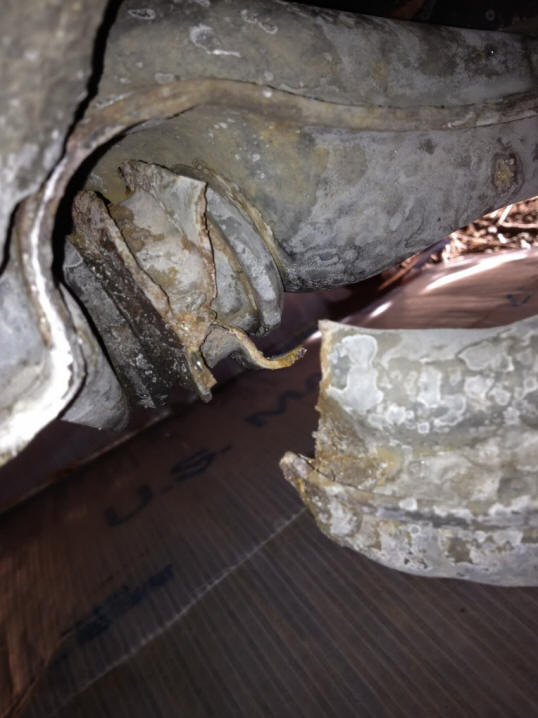
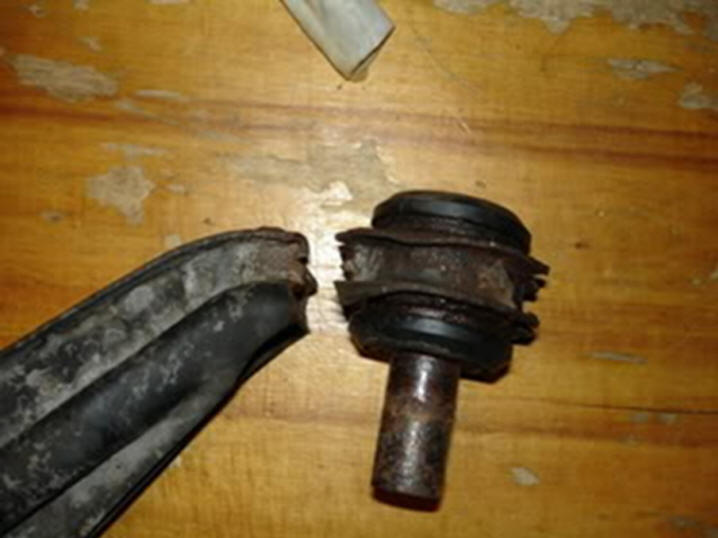
smoothly rotating bushings locking up. If that happens, your suspension components
can literally rip themselves apart. Whenever I make a statement like this, I like to
provide some evidence to back it up, so here are a couple of photos of seized Delrin
bushings for your consideration.
With regard to Taz's front control arms, I decided to swap out the factory arms in their
entirety for a pair of Ford Racing
control arms equipped with rubber bushings 50% stiffer than those in the stock arms and designed with
revised balljoint mounting locations that slightly extended the car's wheelbase for improved handling.
After due deliberation regarding the car's primary mission in life (99% recreational driving on public
roads), as well as past personal experience and reports from reliable sources about the NVH increases
resulting from the installation of various aftermarket front LCA bushing materials, I concluded that the
durometer of the bushings in the Ford Racing control arms was where I wanted to be with respect to
the car's front end ride/handling tradeoff. As always, your mileage - and tolerance - may vary, but I've
been very happy with my choice, which is all that counts around here.
Before installing the Ford Racing control arms on the car,
however, I did replace their preinstalled balljoints with double-height
Steeda
X2
balljoints, which are detailed on this site's Steering
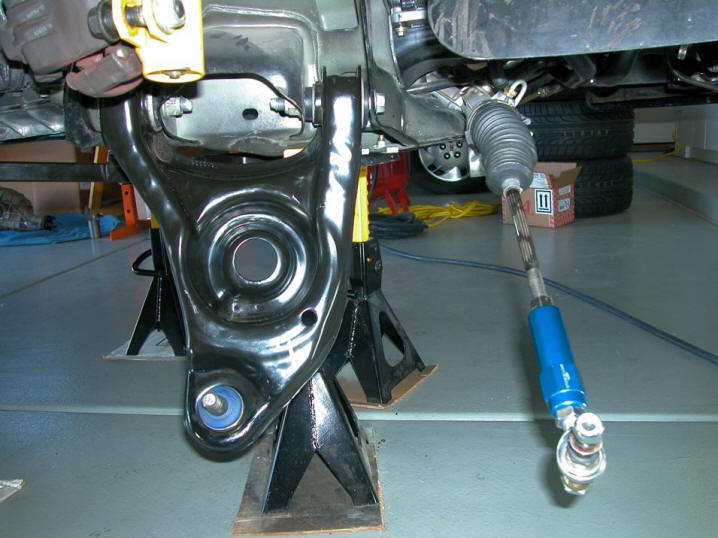
System page. Below is a shot of the right front control arm during
installation, after having been fitted with an X2 balljoint.
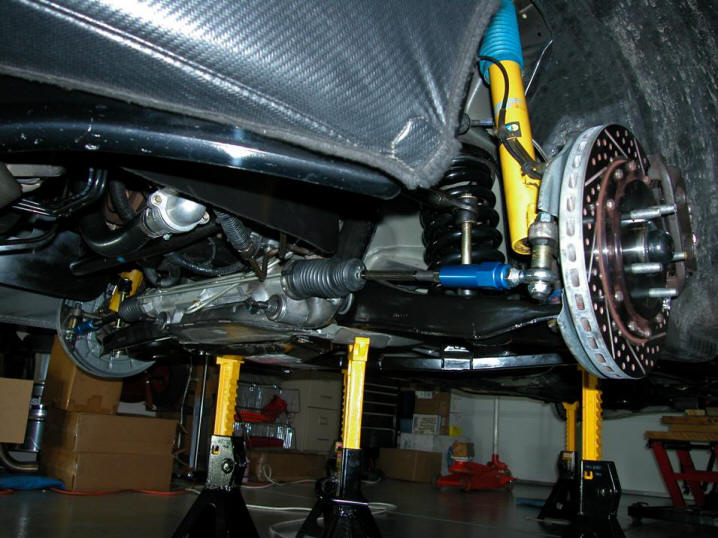
And here's a shot of the entire front suspension ready for the wheels
and tires - after minimizing bumpsteer, of course. Details regarding the
Steeda bumpsteer
kit that you see in these photos can be found on this site's
Steering
System page.
TECH TIP: After making
suspension changes, you should always bump steer the car before having it aligned.
Adjusting bumpsteer will alter the car's toe-in, but adjusting toe will not
affect its bumpsteer.
Another aspect of the Cobra's Round Two suspension upgrades focused on its springs. During
my first visit to the road course at Firebird
Raceway, I quickly realized that my trusty H&R Sport Springs, while very nice on the street,
just hadn't been designed for track duty. I needed different springs, and trading away a little ride quality
for improved handling capability was a compromise I was now willing to make, because I had become hooked on the
road course. After searching long and hard, I settled on a set of Engineered Performance #85245
springs. These were being substituted for the Kenny
Brown Performance springs, which were no longer available. The EP springs were manufactured to
the same specs, by the same supplier that had made the Club Sport springs for Kenny Brown. They even
carried the same part number and came packed in identical cartons. They were Kenny Brown springs in every
respect but name, so I bought a set.
The biggest attraction of these springs for me was that, unlike all the other available aftermarket spring sets,
the EP/KBP front springs were constructed with lower rates than the rears (720 lb/in front,
825 lb/in rear). Why is this arrangement preferable for IRS Cobra owners concerned with handling? Because it helps
to reduce push (understeer) by permitting a little more roll at the front compared to the rear, which improves
turn-in. And heaven knows the SN95 chassis can always benefit from a little less push.
Considering this is a longstanding and widely understood suspension tweak, why haven't other
automotive spring companies followed suit? Liability concerns would be my guess. This is undoubtedly the same
reason Ford suspension engineers dialed in so much push to begin with. What? You thought the Ford
boys were just inept? Think again. Endowing a vehicle with a healthy dose of understeer makes it safer for the
"average" (read "incompetent") American driver. In other words, our personal conveyances, just like most everything
else in our lives, have been reduced to the least common denominator, i.e. dumbed down for the masses. Reducing
its push would have made the SN95 platform a much better handler at the risk of making it more dangerous in the
hands of the Great Unwashed. Can't have that, so to avoid potential litigation by those among us who expect to be
protected from their own ineptitude (damned near all of us these days), manufacturers have opted to engineer and
deliver "safer" cars with intentionally hobbled handling dynamics.
This, of course, leaves automotive enthusiasts and malcontents, such as myself, to track down and
apply their own remediation. As far as reversing the front/rear spring bias is concerned, the more adventurous among
us might experiment with creating their own unique spring sets by cannibalizing parts from a couple different commercially
available kits, selecting the front springs from one and the rears from another. The rest of us are more or less left with
either the Kenny Brown springs or coilovers. (Yes, their reversed spring rates account for the majority of the
handling improvement attributed to coilover conversions on IRS Cobras. I'll bet you didn't know that.)
After driving on my Kenny Brown/Engineered Performance springs around the same road course where I
had run the H&R Sport Springs with the same car, I can tell you that the handling improvement at or near the limit
is huge. Turn-in is vastly improved, and the helm more faithfully tracks driver input. Additionally, because of
the linear rates of the new springs, abrupt throttle changes and extreme braking upset the chassis far less than they did
when I was running the H&R springs with their progressive-rate front coils. Although this spring swap was accompanied
by numerous other suspension tweaks, the handling contribution provided by the new springs remained distinct.
Editorial Comment:
If you're not prepared to live with some increased bump harshness, don't install performance
springs - either conventional or coilover - on your car. Yes, there are nimrods running around on crack or acid who will tell
you their cars actually ride better, or at least as well, after being fitted with stiffer suspensions, but that's completely
delusional. They don't. They can't. The simple truth is that if you manage to get everything right, your car will HANDLE better
with performance springs, but it will NOT ride better! H&R and a few of the other spring companies attempt to mitigate the
increased harshness of stiffer springs somewhat with progressive rates at one or both ends, and they have been reasonably
successful in that regard, but progressive springs are less predictable near the limit than linear springs.
Be realistic. Expect a ride/handling trade-off to accompany every performance-oriented
suspension upgrade you perform. Although Taz now handles like he's on rails, he also rides much more like it, as well. His '06 - '07
suspension upgrades have put his ride harshness close to my personal tolerance limit when traversing some of the bombed out streets
in my town. I don't even want to think about how brutal the ride would be if I had opted for even less forgiving bushings than
poly. No thanks. Sure, the harshness of a very stiff suspension does subside at higher velocities. For example, at 80 MPH and above,
Taz's ride motions drop into a sweet spot where this suspension setup feels perfect, but it's difficult to achieve those speeds around
town and retain one's driving privileges.
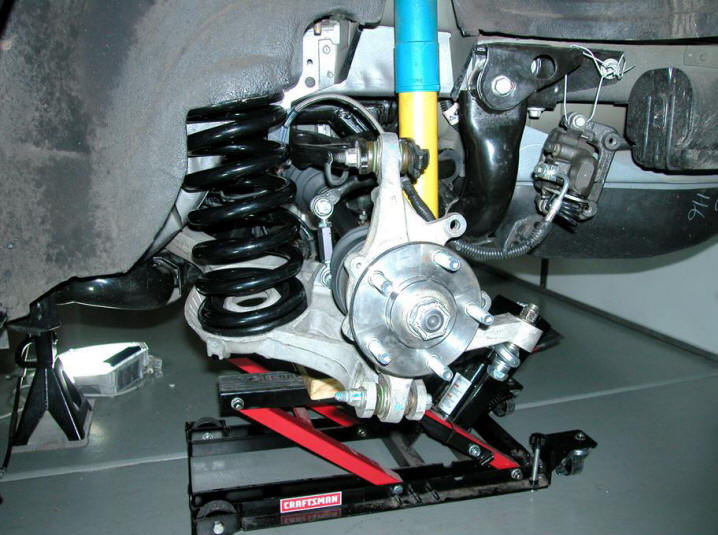
Except perhaps for color, one spring looks pretty much like
another. Still, you can clearly see the massive wire gauge of the rear EP
spring in the photo below. Compare this spring's wire size to the OEM
spring and H&R Sport Spring that are pictured near the top of this page.
In this photo, you can also see
one of the
Max Motorsports MMRSB-94 adjustable sway
bar end links. (I installed the new end links to eliminate the
preload on the rear sway bar that had been introduced by lowering the car.)
After I installed my Kenne Bell twin-screw kit, the H&R Sport Springs had dropped to a
front ride height of just 26.375 inches from the fender lip to the deck (compared to 26.5 inches prior to my addition
of the blower kit). Switching to the EP spring set increased the car's front ride height to 27 inches (but dropped
the rear from 27.5" to 27.0") following some transitory initial settling. This remains unchanged after years of hard use.
Taz now displays no visible forward rake, but has more road clearance up front, so I have not experienced any rubbing or
scraping with the EP springs.
NOTE: Bear in mind that
I run tires
an inch taller than stock, so you should deduct approximately 0.5" off the above
ride height measurements for an estimate of what the ride height would be with stock diameter
tires. (Factory stock diameter was 25.67". If you are unsure of the diameter of your
own tires, use the
Tire & Drivetrain Calculators
on this site's Tech Docs page to determine what you
have.)
If you'd like to have annotated copies of Taz's 2006 - 2007
driveline and suspension upgrade installation photos, including the photos you
see above, just right click the link below and select the
"Save Target As ..." or
"Save Link As ..." (Firefox) option from the fly-out menu that
will appear. This is a fairly large file (more than 5MB), so it may take a
minute or so to download, but that's still preferable to the delays you would
otherwise encounter trying to view the file in place via the Internet.
2006 - 2007
driveline & suspension upgrade installation photos (PDF)
Editorial Comment:
What about switching to a coilover setup? Isn't that better than a conventional
spring/damper arrangement? Yes, for a chassis that was designed to accommodate coilovers and has been
adequately reinforced to support them. However, after weighing all the advantages and disadvantages of
changing a New Edge platform to a coilover suspension, I elected to stick with an upgraded rendition
of the factory architecture. Considering the reasonably obvious fact that a coilover suspension would have
been less expensive to produce than the OEM setup, I think Ford also must have concluded that the overall
disadvantages of a coilover arrangement for the SN95 outweighed the advantages. By the same token, many
New Edge Cobra owners have switched to coilovers, and many - although not all - of those folks say they
have been satisfied with their results.
In the final analysis, the call is yours, but fact that the SN95's
strut and shock towers were neither engineered nor constructed to bear the full burden of supporting the car's
weight should be apparent to even the most casual observer. And the addition of braces simply cannot compensate
for the structural inadequacies of those towers. Beyond this drawback, all sleeved coilover kits further compromise
suspension reliability, and the only kits for the SN95 of which I'm aware that do not rely on sleeves are the Kenny
Brown kits, which START at about $2700 and the KW Variant kits, which can set you back up to four grand. This is
CONSIDERABLY more than a pair of comparable struts and your choice of performance springs would run, and you'll
still need to beef up the towers, which will cost another bundle if you're not prepared to tackle the welding
yourself.
Then, there are the issues of ride quality degradation and increased NVH.
These are not speculation. They're tangible and worth considering. Here's what the previous owner of an IRS Cobra
had to say about his former coilover setup:
"I had the best coilover setup and
K-member in my 03 Cobra ... and I would never put coilovers in a street car again. Nor would I install any of that lightweight
front end shit on a street car. IT ALL MAKES WAY TOO MUCH NOISE AND CREAKS!! Plus it bottoms out and never rides like
the factory parts. There's always something that's annoying. It's just not worth it. You will hear from people that
their shit is perfect but they need hearing aids!!! ..."
His words, not mine. But it's your car and your choice, so
do what you want. I'm merely pointing out the downside, because apparently SOMEONE has to represent the voice of reason when it
comes to things like this! Here's another owner's comment for your consideration:
"I recently purchased my 03 cobra, it has [respected brand] coilovers all the
way around. When I first got it, I thought I could tuff out the noise, BUT I CAN'T. They are just obnoxious loud and creaking
and popping constantly. ..."
Some owners claim their coilover conversions aren't noisy. Maybe that's true, maybe
not. Regardless, the way your car turns out will be a crapshoot. Furthermore, switching to coilovers will require running
quite a bit of negative camber to address interference issues. Enough to result in uneven and accelerated tire wear. As I said,
the SN95 platform wasn't designed with coilovers in mind.
IRS Subframe Bolts
To expedite assembly, the Ford factory used 12mm, rather than the correct
14mm, bolts to secure the front of the IRS subframes to the chassis of most Cobras. (FYI, 9/16"
bolts are NOT the correct size, either. Those are close to the right size, but a
little too large, so they generally require a BFH to force them in - or out. All fasteners on the
car are metric.) When folks began complaining about their IRS cradles shifting around because of
the slop created by the small bolts,
Maximum Motorsports made the proper 14mm bolts and nuts available to remedy the problem.
I swapped out my 12mm OEM bolts for the MM 14's while reinstalling the IRS cradle, after
completing the 2006 - 2007 IRS upgrades. The
14mm hardware
is shown on the left in the photo below. A pair of
MM low profile rear IRS
subframe bolts are depicted at the right.
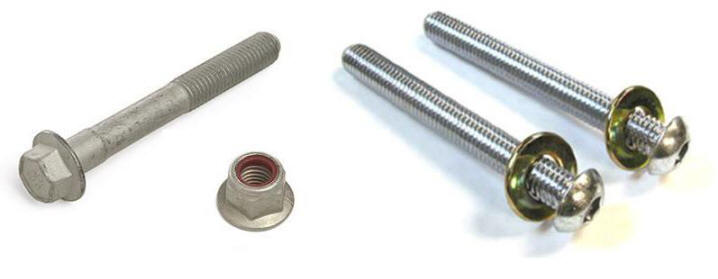
Even though the low profile bolts shown above are
marketed for individuals who want to run tires wide enough to encounter
interference issues with the stock bolts, and Taz's 275-width rear tires were
nowhere near wide enough
to present a problem, I installed a pair of the low profile bolts
anyway. A stock rear IRS bolt can be seen in one of the Suspension
Upgrades, Round 2 photos farther up this page, because the low-profile bolts
hadn't yet arrived from Max Motorsports when I shot that photo. However, they showed
up shortly after that shot was taken, just in time for me to get them on the car before
reinstalling the wheels and tires.
Poly Motor Mounts
After several thousand miles of service above and beyond the
call of duty, the rubber OEM motor mounts cashed in their chips.
They simply hadn't been designed to handle either the enhanced torque of the
supercharged engine or the extreme lateral g-forces encountered during the car's
autocross and road course outings. The untimely demise of the motor mounts was
accompanied by a great deal of banging-clanging commotion under hard acceleration
and a rise in overall chassis impact harshness when driving over broken road
surfaces. Even worse, the unwanted engine movement would eventually result in
driveline damage. The mounts had to be replaced.
Realizing that installing a fresh set of OEM parts would
eventually result in another occurrence of the same situation, I researched my alternatives.
Initially, I anticipated that a set of Terminator motor mounts would provide
a suitable upgrade, but I then discovered many complaints of broken mounts among
Terminator owners. Consequently, I discarded those from further consideration
and focused my investigation entirely on the various polyurethane offerings. Solid mounts weren't
contenders, because they're far too brutal to suit me.
During my research, I discovered that not all poly motor mounts
are created equal. It seems the Energy Suspension
motor mounts, which are based on the company's patented Hyper-Flex
formulation, are much more compliant than the other brands. People who had
installed the Energy Suspension mounts were invariably pleased, while
those who had installed mounts from other manufacturers generally complained
about the increased levels of NVH that had accompanied their installation. Based
on the fairly consistent owner feedback, I decided to
try the Energy Suspension
mounts, which I purchased and installed during the summer of 2009.
My hat goes off to those who have managed to install fresh motor mounts on SN95 Mustangs without first dropping their K-members,
at least those with factory K-members. I
briefly considered trying this myself, but thought better of it as soon as I
began the work. Having by this time previously dropped Taz's K-member, I realized
that path offered the least resistance, so that's what I did. This turned out to
be the right call, and the swap went so uneventfully that I didn't
even bother to shoot any photos during the process. However, I later snapped
a shot, reproduced below, of the old OEM mounts after their removal.
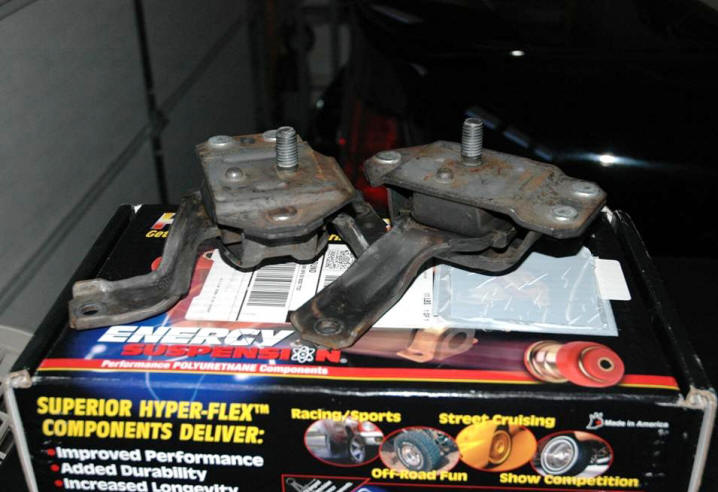
Aside from the distortion of their rubber isolation blocks,
there's very little visible deterioration in the old mounts - not a single crack or
split to be seen anywhere on the exposed rubber surfaces - but they were definitely shot. Before
removing each from the engine block, I grabbed it and wiggled it around. Each
moved far more easily than it should have.
Additionally, both mounts - particularly the right one - were severely compressed,
which had put the oil pan perilously close to the factory K-member brace.
Even though the swap was extremely straightforward, I recorded
detailed notes that include each step
of the procedure necessary to drop the K. If you're among those who may be a little unsure
or apprehensive about
dropping your car's cross-member in order to gain access to parts obscured behind it, check
out the Adobe PDF document linked below, and you'll see how easy it
really is. Although some of the details in these notes are specific to my car
and its particular parts, the general procedure should be adaptable to any SN95.
Dropping the K-member to
Replace the Motor Mounts (PDF)
As for the Energy Suspension mounts, they have earned my
enthusiastic and unqualified endorsement. Although I must concede that they're less compliant
than a fresh set of OEM mounts would have been, I am experiencing a very acceptable level of
NVH with these, and they should enjoy greatly extended service lives compared to the OEM parts.
As expected, the commotion during hard acceleration has disappeared, indicating that I'm no
longer beating up my driveline. Beyond that, I imagine I'm losing less power to unwanted engine
movement.
Rear Sway Bar
As previously mentioned on this page, permitting a little more
roll at the front of the vehicle compared to the back improves turn-in, reducing
push (understeer). Early in 2012, when my friend Joe informed me that the
Eibach sway bars were
being offered by one of the Internet parts vendors at fairly healthy discounts,
and that Eibach was further sweetening the pot by providing factory
rebates, I found it impossible to pass up such an appealing offer. Even though
Taz's suspension had been well sorted out for years, the car continued to demonstrate
some residual understeer. Although I feared this was an incurable SN95
affliction, I hoped a stouter rear bar might alleviate the
lingering push, if only by a little.
I wasn't expecting an earth-shattering improvement, since I had
read very few glowing reports regarding the benefits afforded by aftermarket sway
bars. But the majority of Mustang owners, who typically throw parts at
their cars with little understanding of the engineering behind those parts or the
ramifications of installing them, almost always bought and installed complete kits
containing both front and rear - supposedly "matched" - bars. (If one
is good, two must be better, right?) Unfortunately, aftermarket parts suppliers,
who are generally every bit as sensitive to liability exposure as automotive
manufacturers, are likely to calibrate their sway bar kits for a healthy dose
of understeer in order to "protect" the less capable among us from
themselves. I suspected that the installation of these complete kits was the
primary reason why people weren't reporting more impressive results with the
aftermarket bars, but I was uncertain as to what extent the inherent push of a
New Edge Cobra could be reduced by installing only a stiffer rear bar and leaving
the front end well enough alone. Nevertheless, given the bargain basement pricing,
I intended to find out, so I bought a rear bar kit, which included fresh
urethane bushings in addition to the bar itself.
Several sources, including the Ford shop manual, stated that
the prescribed method for replacing the rear sway bar of an IRS-equipped Cobra was to
partially drop the rear suspension cradle. Recalling from past experience the
amount of work that entailed, and not anticipating any sort of miraculous
transformation, I was in no particular hurry to install the bar, so it sat in my
garage for a couple months. However, I immediately realized after taking a good
look at everything back there while the car was on stands for an oil change that
access to the bar and its brackets could be gained by dropping the fuel tank,
instead of the IRS cradle. I was already shopping for a tank upgrade, so I
decided to perform the two installations together after I'd procured a suitable
tank. This I did, and as the photos below clearly demonstrate, the bar and
brackets are readily accessible with the fuel tank out of the way.
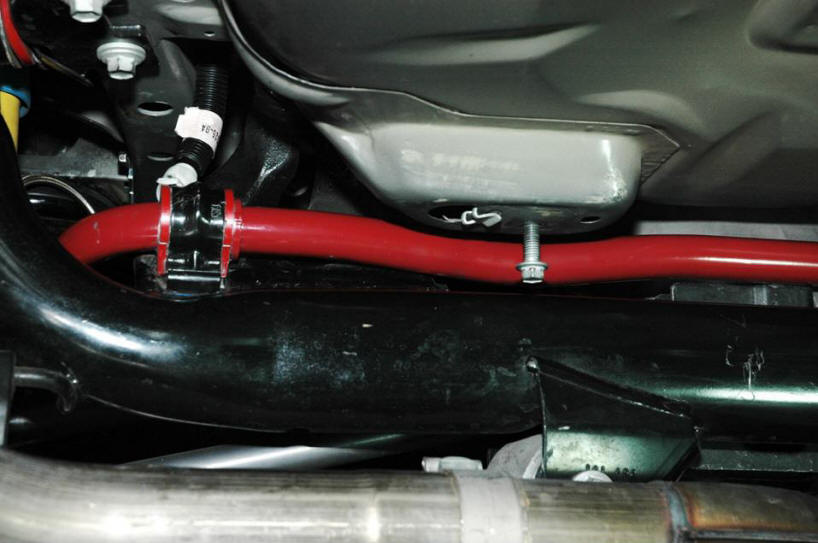
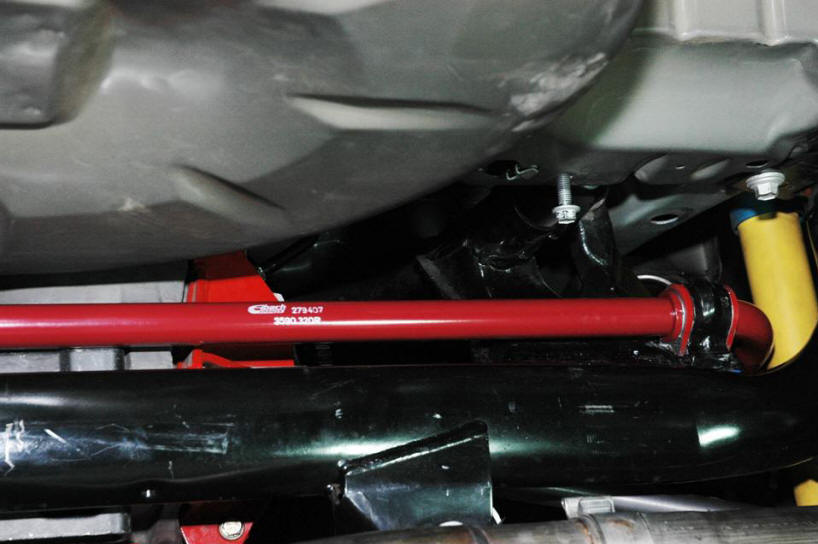
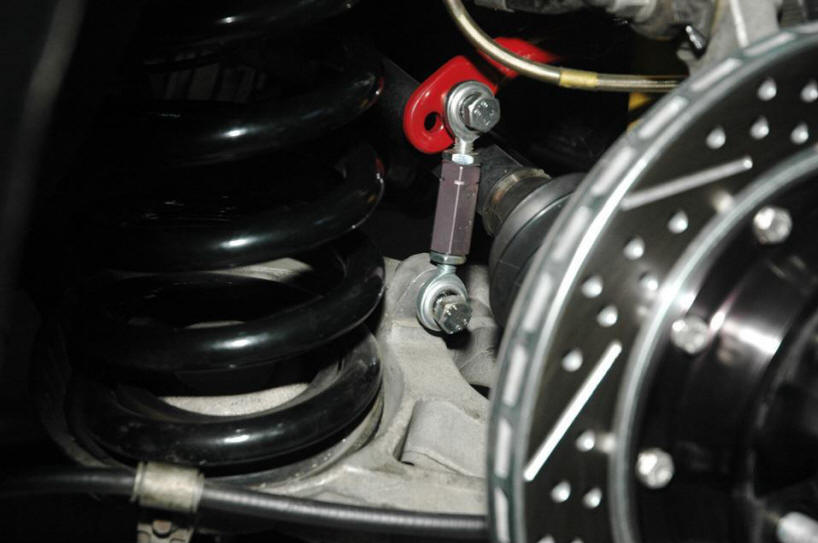
During the installation, I was able
to select the bar's back (stiffer) end link attachment holes. However, I'm
fairly certain that I would have been forced to use the front holes if I had
been running stock halfshafts. As you can see in the photo below, although
perfectly vertical with the suspension loaded, the end links swing very close to
my DSS Level-5 axle bars at full droop. I suspect I'd have encountered
interference problems there with the OEM axles, because they are somewhat larger
in diameter than the L-5's. (See Taz's Drivetrain
page for a comparison photo showing the two axles side by side.)
Of course, the entire point of this exercise was to reduce
understeer, so the question foremost on my mind was how effective the
installation of this bar had been with regard to that objective.
My first drive after the upgrade unequivocally answered this question.
What a difference! Taz's turn-in was spot-on. He went exactly
where I pointed him. However, I was amused to note that I had become so accustomed to
automatically compensating for the residual understeer that still remained after all the
earlier suspension and steering tweaks that I now found myself consistently overcorrecting
the car’s path. It was apparent that I'd to need to acquaint myself with Taz's handling behavior
all over again, but that would be fun and a small price to pay for achieving the absence of
understeer.
As always, your mileage may vary. This bar provided precisely the correction to Taz's
turn-in that was required to completely eliminate all his residual push, but it may not benefit your car
as greatly due to other chassis, suspension, and steering differences. Nevertheless, installing this
bar - just the back one - will go a long way toward reducing any IRS-equipped Cobra's
understeer. Even though Joe's Terminator is set up somewhat differently from Taz, and even though he
was forced to use the bar's forward end link attachment points, he too observed a
remarkable improvement in his Cobra's turn-in when he installed his Eibach rear bar. Two for
two, while perhaps not statistically significant, is a pretty good batting average, and you can take
that to the ball park.