

















|
Instrumentation Upgrades
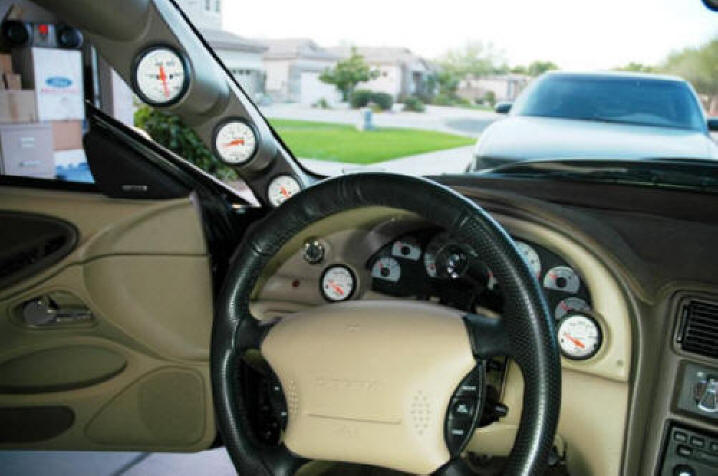
By the end of 2008, Taz's miscellaneous electrical upgrades had become so extensive that this page was very slow to load due to the abundance of graphics it contained. To alleviate the problem somewhat, I moved all of Taz's instrumentation upgrades, which previously had been included here, to their own page. The Cobra's instrumentation tweaks had become extensive enough by then to warrant a page of their own, anyway. You can now read about the car's instrumentation upgrades by clicking either the hyperlinked text or the photo below. Jump to Instrumentation Upgrades page
MAFterburner+
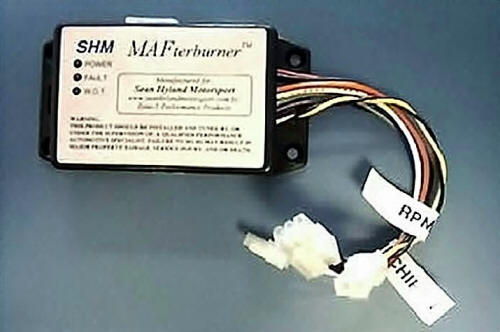
After I bolted my ported intake in place in 2002, the car ran for only a few days before throwing diagnostic trouble codes (DTC's) indicating lean conditions in both banks. The Cobra's powertrain control module was apparently unable to compensate for the increased flow of the ported intake coupled with the C&L MAF meter's poor calibration at low flow rates. Luckily, I already had a remedy for this little problem in my garage collecting dust. All I needed to do was to install it. Mark Chiappetta at Zone 5 Performance had developed a device for tweaking a car's fuel trims, and I had picked up one the units during a group purchase. The so-called MAFterburner was capable of effectively manipulating any MAF meter's transfer function, and it was delivered with Windows-based software that enabled graphical adjustment of the fuel trims at multiple points across the engine's RPM range. Here's a stock marketing photo of a MAFterburner for reference. Sorry about the image quality, but it was lifted from an Internet site.
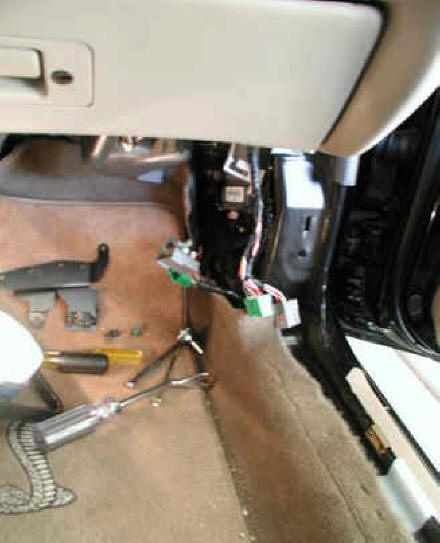
A few PCM wiring harness modifications were necessary to splice the MAFterburner into the vehicle's MAF sensor circuit. But thanks to excellent documentation, installation of the unit was a snap.
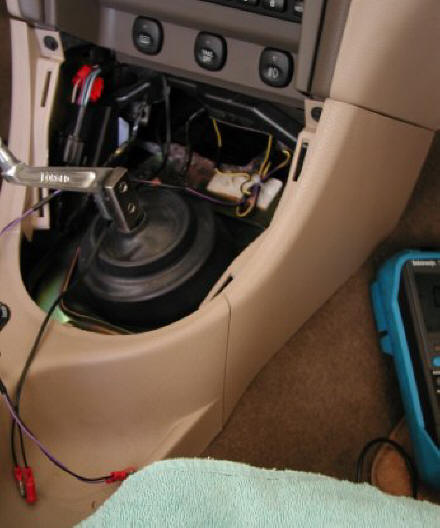
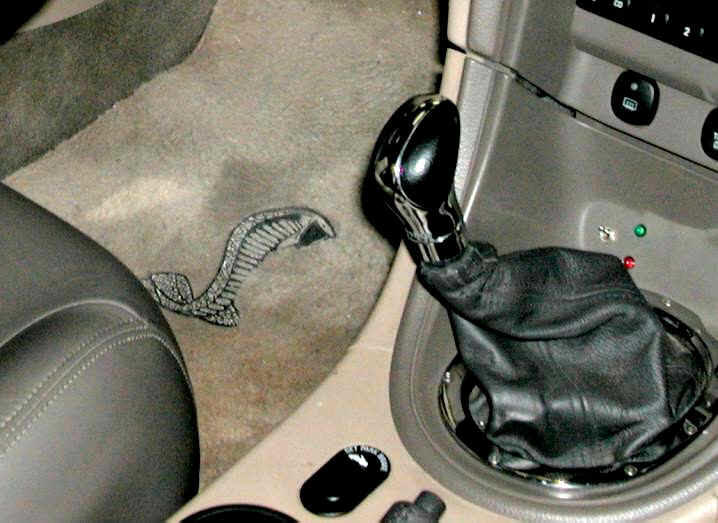
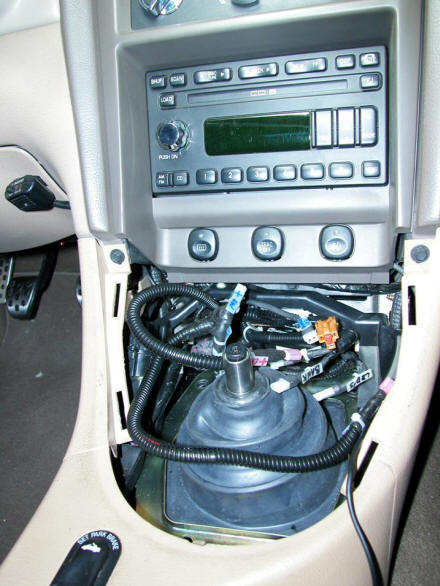
I had purchased the "Plus" version of the MAFterburner (later renamed the "Stage-2" model), which supported two different sets of fuel trim calibrations, so a bit of additional wiring work was required to provide trim switching capability and visual indication of which tune was active. I decided to mount a mini-toggle and a pair of LED's in a blank spot on the trim panel at the base of the center stack. Here's a shot of the MB+ wiring ready for installation of the modified trim piece. (This photo also shows the forged handle of the Steeda Tri-Ax short throw shifter that had replaced the TR-3650's stock unit at some point along the way.)
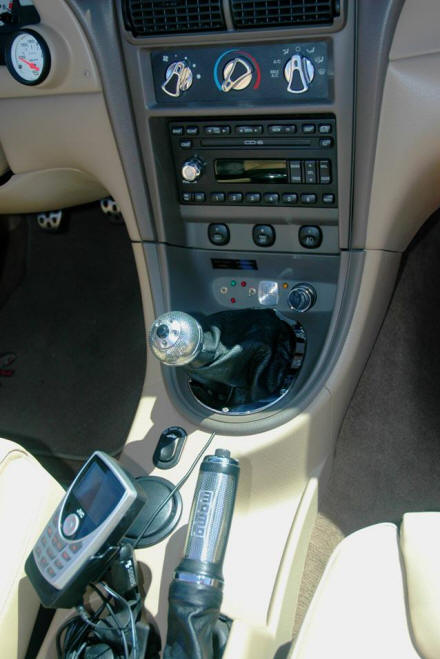
The MAFterburner did the trick. Once I had applied the appropriate tweaks to the MAF meter's transfer function, the PCM was perfectly content, and the DTC's never again returned. Here's a shot of the finished work. In this photo, you can see the Momo "Cobra" shift knob that was installed at that time.
I left the MB+ in place after removing the ported intake and C&L MAF meter to install the car's twin-screw blower kit, but I reconfigured its operation. One program in my MAFterburner is now configured to provide ZERO compensation for both closed loop and open loop PCM operation. When this program is active (most of the time), the engine's fuel management system operates as if the MB+ weren't in the circuit at all. The second program is configured to lean out only the open loop A/F ratio by a few points across the board to provide a custom "shootout" mode for use with racing fuel. (Closed loop compensation remains zeroed out, even in shootout mode.) It's nice to be able to instantly toggle from one program to the other with the flip of a switch. Maybe, I'll test the effectiveness of this capability one of these days during a dyno session, so I can quantify the performance improvement that it provides. Maybe not. NOTE: The MAFterburner unit is no longer listed as a current product on the company's website. It was probably discontinued because its functionality has been incorporated into the plethora of handheld tuners that have flooded the market in recent years. I continue to use mine, because I don't want to risk compromising the Kenne Bell tune that has been programmed into my performance chip, and my MB+ enables me to make adjustments to my A/F ratio without changing anything in either the chip or the PCM.
Black Box II
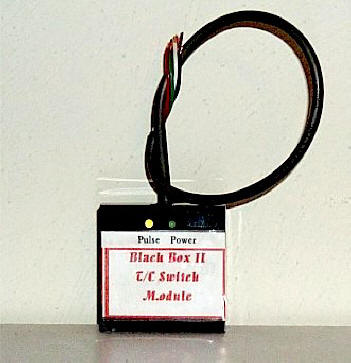
To placate the Safety Nazis, Ford engineered the Cobra's traction control circuitry to default to ON every time the car is started, regardless of its previous setting. This is accomplished through the use of some simple digital logic circuitry. The pushbutton switch in the center stack does nothing but pulse a digital flip-flop to toggle the T/C off or on. While I agree that traction control assistance has its place, and that it can be very useful in certain adverse conditions, I also believe that it hinders performance by retarding ignition timing whenever the rear tires break loose. I almost always wanted the T/C off, and after the supercharger installation, it became vitally important to ensure the T/C circuit was de-energized most of the time. Remembering to manually disengage the nanny circuit had always been a nuisance, and I forgot more often than I remembered. But I eventually stumbled across a handy little device that made life with my traction control nanny much easier. The little unit, appropriately named the Black Box II, automatically restores the T/C circuit to its previous setting, rather than defaulting to ON, each time I start the car. Installation was very straightforward, and the unit now resides quietly inside Taz's console, near the T/C switch. SCORE!
If you're interested in one of these, R and R Specialty Auto Electronics offers a similar unit.
HID Bi-xenon Retrofit Project
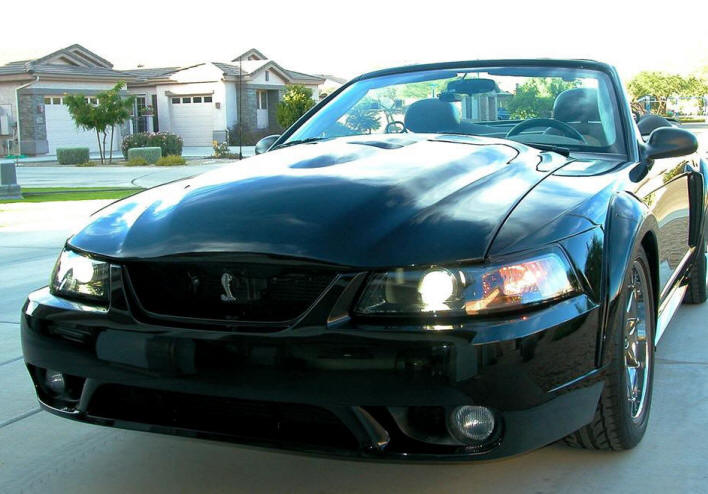
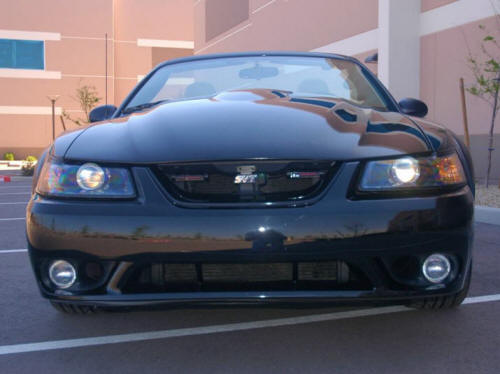
Several years ago, I became fascinated with the prospect of retrofitting the Cobra with HID headlights. Not one of the "Glare Monster" kits that provide only rebased HID light sources for use in unmodified OEM headlamp housings, but a genuine OEM-quality lighting system. Since the Corbra's factory headlights employ the same dual-filament 9007 halogen bulbs for both high and low beam functions, I wanted an HID solution that would also handle both. I spent nearly two years studying the feasibility and considering my options before I finally turned my fantasy into reality in 2005. During my research, I had discovered that a few small companies - mostly garage operations - were willing to modify stock halogen headlamp housings as required to accept genuine OEM projector systems - for a price. (Read NOT CHEAP!) Despite the high cost, I decided that it was in my best interest to have one of these experienced craftsmen provide me with a solution, rather than trying to shoehorn a pair of bi-xenon projectors into a couple of stock housings on my own, so I sent my money, along with a pair of fresh housings, off to one of these companies for the retrofit. Apparently no one had ever before accomplished a bi-xenon retrofit for a New Edge Mustang before mine. There had been a few single xenon (low beam only) projectors stuffed into '99 - '04 'Stangs, but to the best of my knowledge, mine represented the first successful bi-xenon project for one of these cars. Even my retrofitter, despite having successfully completed scores of projects for other vehicles, almost threw in the towel more than once, but he eventually persevered. (Kudos to Sean for finally pulling it off!) Since that time, smaller bi-xenon projector assemblies have made the task considerably easier, and many others have now followed suit. Three months after I initiated the process, the first pair of New Edge Mustang bi-xenon HID headlights arrived at my doorstep, complete with plug-and-play wiring harnesses. Of course, being the anal-retentive perfectionist that I am, I wasn't entirely satisfied with the as-delivered solution, so I performed a bit of cleanup work on the lights. Then, I fabricated my own custom harnesses and control boxes from scratch, and since I couldn't come up with a suitable mounting arrangement for the supplied Denso ballasts, I replaced them with a pair of Philips model LVQ212 units and custom brackets. After countless hours of hard work - not to mention a few hundred more shekels - I finally had exactly what I wanted. The finished project is pictured in the photo below.
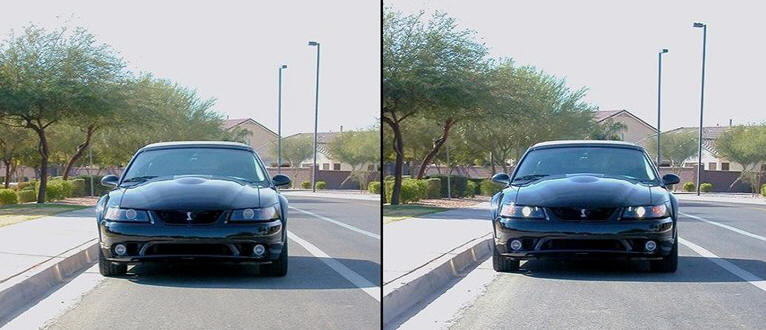
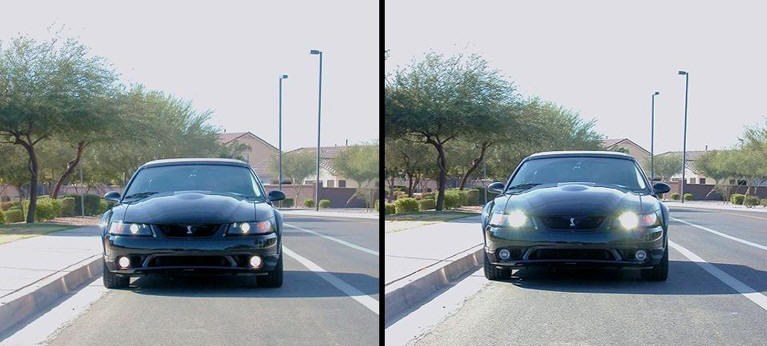
Download the PDF file linked below for a pictorial chronicle of my efforts. One of these days, I may get around to fleshing out the photos with some text. Or not. Meanwhile, if a picture is worth a thousand words, you'll have more than enough to figure out the details. This PDF is BIG, so you may want to right-click the link and select "Save Target As ..." or "Save Link As ..." to save a copy to your own computer. Bi-xenon HID project photos (very large PDF) The series of photos below will give you at least some idea of the difference in lighting quality between my HID retrofits and either the stock halogen lights or one of those nasty HID kits. For reference, the car is pictured at the top left with its lights off. At the top right, the car is shown with its low beams energized. In the bottom row, you can see the way the car looks with both the low beams and the fog lamps on, followed by a shot of the car with the high beams energized.
The projectors in my headlamp housings are Hella units, specifically the same units with which European-spec Audi A6's were fitted at the time. Although I could have selected DOT-spec projectors, I opted for ECE (Euro-spec) units, because I prefer their sharper cutoff characteristics. As shown above, the difference between the low and high beam patterns of these lights is enormous. The low beam pattern is very subdued, and although they light city streets very well, the low beams are never objectionable to oncoming drivers. The high beams are a completely different matter. They'll burn out the retinas of approaching drivers from quite a distance if I inadvertently leave them on. Editorial Comment: Because the light dispersion of rebased HID bulbs installed in stock halogen reflector headlamp housings is uncontrolled, those setups invariably look like high beams to oncoming drivers. The glare they produce can get you shot in some places, and not a moment too soon, as far as I'm concerned. Additionally, the light produced by rebased HID lighting kits is worse than no light at all in heavy fog or rain, because all that scattered light bounces right back into your face. This characteristic is also the primary reason that, from a functional standpoint, HID light sources should never be installed in fog lamp circuits. They'll dazzle you blind in foggy conditions. Let's be clear on this. If you install rebased HID bulbs in any sort of halogen reflector housings simply because you think they look cool at night when you're gazing admiringly at your car from the side of the road, you're a MORON, pure and simple. Clear enough? Your headlights were put there to help you see down the road in the dark. HELLO! They are NOT there for decoration, self-expression, or artistic interpretation. When you decrease the ability of your lights to do their jobs, you're demonstrating a complete absence of intelligence. And when you callously blind oncoming drivers in the process, you're making a public menace of yourself. Make no mistake about it. The only way to actually improve your vehicle's lighting performance, rather than making a complete ass - not to mention first-class annoyance - of yourself when switching from halogen to HID lighting is the way I and others like me have done it. You must transplant an entire OEM HID system into your car. An HID kit will NOT improve your vehicle's lighting performance. It can't, because it cannot defy the laws of physics. QED Another characteristic of my lights that is obvious in the photos above is their color temperature. My HID bulbs are very close in color temperature to the color temp of the Sylvania Silverstar halogen bulbs in my fog lamps (4300K for the HID's vs. 4100K for the Silverstars). This is the same color temperature that all auto manufacturers use for their original-equipment HID systems, which makes sense, because this color temp provides the best lighting. Period. Bulbs closer to the blue/violet end of the color spectrum provide less effective lighting performance. Since my motivation for this project was to improve my ability to see down dark roads at night, I wasn't about to shoot myself in the foot by installing the wrong color temperature bulbs. Editorial Comment: While blue/violet headlights may look "cool" to some folks (primarily the low-rider and gold chain sets), they're grossly inferior from a lighting standpoint. Anyone who knows anything about lighting is aware of this, so how do you think idiots sporting blue/violet headlights look to any informed observer? That's right. Just like the retards that they are. How "cool" is that? Dual beam halogen bulbs, like the 9007's with which Taz was originally equipped, contain two different filaments, so switching between their high and low beam patterns was as simple as energizing one set of filaments or the other, but switching between high and low beams is performed differently with bi-xenon HID lights. High-voltage gas discharge lights don't take kindly to being rapidly switched on and off, such as in a "flash to pass" situation, and this can quickly destroy the ballasts. Since they can't be quickly toggled on and off like lamps with filaments, bi-xenon HID's employ a solenoid-actuated cutoff shield to provide the change in beam pattern. For low beam operation, the solenoid is de-energized, and the shield blocks light above the cutoff level. Switching to high beams energizes the solenoid, which pulls the cutoff shield away from the light beams. The solenoids are rigidly mounted to the projector frames, along with the bulb sockets and optics, and each solenoid is equipped with a two-wire (Hella) or 3-wire (Bosch) harness for connection to the vehicle's headlamp dimmer switch circuitry. Some of the plug-and-play HID headlight kits that rely on rebased bulbs attempt to provide both high and low beam functionality with what are often called "wiggle lamps." These kits claim to be bi-xenon, but they are not, because they don't implement high/low beam functionality as described above. Rather than being rigidly secured in their bases, the bulbs are allowed to pivot up and down, and electro-magnets are employed to shift their positions. The term "wiggle lamps" is certainly appropriate here in more ways than one, because that's exactly what you get in lighting performance, as well as lamp construction. Since these bulbs aren't rigidly mounted in the vehicle, the beams they throw are continually bouncing all over the place. Great for disco parties, but not so hot for driving in the dark! Another difference between HID's and halogens that is worthy of note is that the actual operating current requirement of HID headlights is much lower than that of halogen lamps. Then, why the need for relays and heavy gauge wiring with HID's? Simply put, gas discharge lighting systems employ devices called igniters to fire up their light sources, and these igniters draw quite a bit of current while energized. Although the duration of this high current demand is brief, the addition of relays and stout wiring to power the ballast-igniter units is strongly recommended to avoid deterioration of the OEM headlight wiring. TECH TIP: In Generation III HID headlamp systems like mine, the bulb igniters are built into the ballasts. This limits ballast mounting options, because the high-voltage cable between each ballast and its light source must be kept as short as possible to minimize voltage drop, as well as noise that could interfere with the vehicle's ignition and other systems. In the newer Gen IV systems, the igniters have been relocated to the backs of the bulb connectors in order to provide more ballast mounting flexibility, but this adds to the amount of clearance required behind the headlamp housings. There may be insufficient clearance behind the housings in a New Edge Mustang to accommodate the Gen IV system's topology, so be cognizant of which type you're buying if you're thinking about installing a retrofit system.
OEM Audio System Modifications
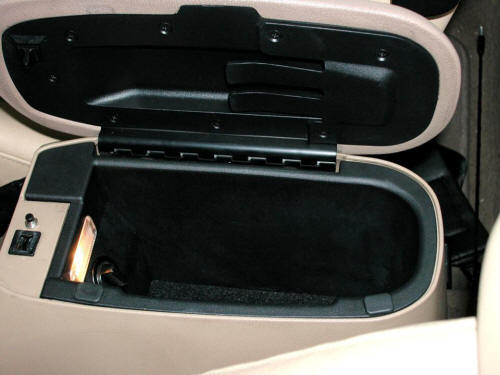
The 2001 through 2003 Ford Mach-460 audio head units are equipped with "Worldplug" 3-receptacle connector systems. (2004 head units do not use the same style connectors.) These double-DIN sized units possess not only built-in multi-disc CD players, but also the signal and control circuitry required to accommodate a second, external disc changer or other auxiliary audio source, such as an MP3 player, a satellite receiver, etc. Another standard feature built into each Mach 460 is speed-sensitive volume (SSV) circuitry, but this SSV capability remains dormant in the Mustang incarnation of the unit. (I suppose some bean counter figured he'd save Ford a nickel per car by eliminating the single wire and connector necessary to tie the SSV circuit into the signal from the vehicle's speed sensor.) For years, I did nothing about hooking up the head unit's SSV circuit, because I just didn't listen to the audio system often enough to warrant the effort. About the only times I enjoyed hearing some tunes in the car were during long road trips, and in that setting, I could adjust the volume for highway cruising and forget about it. Around town, the audio system usually remained off, because I preferred listening to the Cobra's mechanical song. Sadly, listenable FM stations were/are few and far between on the highway, so I began toying with the notion of adding a satellite radio receiver to the car and feeding the signal to the OEM audio system via its auxiliary input. In mid-2005, I purchased a small JVC SIRIUS satellite radio receiver, complete with matching mobile, home, and portable kits, but I postponed tying it into the car's Mach-460 for several months. Although I had been reading for some time about a product from a company named Precision Interface Electronics that claimed to make connecting any external audio source to a Mach 460 head unit a clean and simple procedure, some controversy had arisen among New Edge Mustang owners about whether or not the "PIE adapters," as they were called, really did work as advertised in our cars, and I wanted confirmation before proceeding. Finally, by January 2006, enough people had reported positive results with their PIE adapters for me to feel reasonably confident about making one work in Taz. I ordered mine directly from the manufacturer, and it arrived at my doorstep just a few days later. Since I needed to pull the head unit out of the dash to install the PIE adapter anyway, I decided to also connect the unit's SSV circuit to the vehicle speed sensor at the same time. I am pleased to report that I managed to accomplish both objectives with relatively little drama. Afterward, Taz's audio system boasted speed-sensitive volume and was able to play audio from my SIRIUS receiver or any other external audio source, such as my MP3 player. With regard to mounting the little JVC receiver, I was delighted to discover that the car kit's windshield mount slipped nicely down into one of the console cup holders once the rubber boot had been removed from the recess. Since the mount was nicely articulated at both ends, I was able to easily reorient the receiver any way I liked. Using this mounting location also made it easy to obtain the requisite 12V power for the receiver from the auxiliary power port inside the console's storage compartment. I was able to store most of the extra wire inside the console, as well, so the interior still looked reasonably neat with the receiver sitting in the console. This is the way everything looked with the JVC hooked up:
2009 Update: In 2009, I rerouted the auxiliary audio signal cable (visible above) through the console, so it emerged between the emergency brake handle and the rear cup holder for a much cleaner appearance. For those of you who are interested in making similar modifications to your own Mach-460's, I shot a few photos while performing these upgrades, and I threw them into a PDF with a simple circuit diagram detailing the connections. Sorry about the quality of the photos, my former digital camera had become possessed. (Even though the problem was most likely pilot error, I subsequently replaced that camera with a better one.) Anyway, here's a link to the file: Mach-460 modification wiring diagram & photos (PDF) 2011 Update: The OEM audio system modifications were
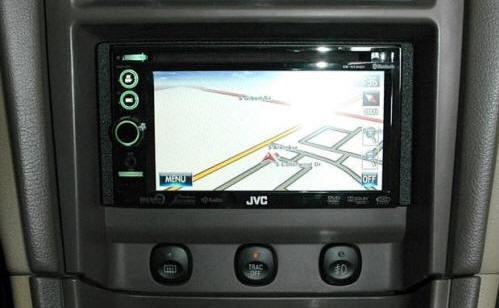
superseded by replacement of the Mach 460 head unit with a JVC in-dash navigation/media system. Refer to
the related section farther down this page for details about that project.
FRPP Speedometer Recalibrator
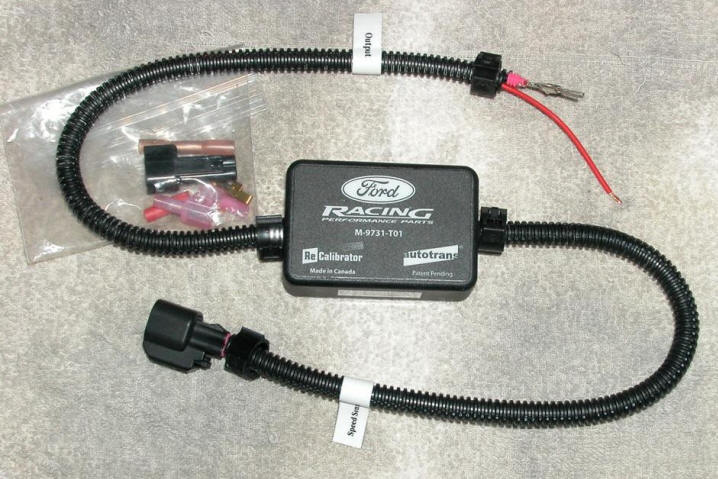
When I performed Taz's 2006 - 2007 drivetrain upgrades, I also installed a Ford Racing speedometer recalibration unit to compensate for the change in overall gearing and restore the accuracy of the car's speedometer. I found a ledge inside the base of the center stack where I could stash the little unit and still remove it again later to recalibrate for future gearing or tire diameter changes. The unit I originally purchased for installation is depicted below, but this turned out to be the wrong unit for a Ford Racing '00R T-56 (Tremec # TUET-1260).
The above model will probably work fine for a takeout transmission from a Terminator Cobra, but it is equipped with the wrong OSS (Output Shaft Sensor) connector for the '00R model. It seems the 2000 Cobra R's T-56 uses the 1999 style connector, rather than the 2001 and newer style. The correct unit, FRPP # M-9731-T99, looks identical to the one pictured, except for the connector. Inside the little plastic case, in addition to the requisite electronics, is a bank of DIP-switches that can be adjusted to provide whatever percentage of compensation is required to produce an accurate speedometer reading on the gauge. To enable the unit's OSS harness to reach the transmission from the case's resting spot in the center stack, I created a passage in the metal baseplate of the outer shifter boot. This same portal also accommodates the power circuit for the T-56 transmission's REVERSE solenoid. Both circuits are diagramed in the PDF file linked below. T-56 speed calibration & reverse solenoid circuits If you have one of these little gems, and you need a copy of the DIP-switch chart, you can find one here: FRPP Recalibrator DIP-switch Chart
Reverse Solenoid Circuit
When I installed the Ford Racing speedometer recalibrator, I also designed and installed a switched power circuit for the REVERSE solenoid of the T-56. (Since the car's OEM TR-3650 hadn't been equipped with a reverse lockout, the car possessed no such circuitry.) Many who retrofit their vehicles with T-56 transmissions simply tap into the brake light circuit to activate the solenoid whenever the brake pedal is depressed. This is a quick and easy solution, but I wanted more positive control over exactly when and how long the solenoid was energized. Others install console or dash mounted switches, but those either make engaging reverse a two-handed operation or they employ maintained contact switches that must be manually deactivated. I wasn't especially keen on either alternative. I wanted positive control and single-handed engagement of reverse without having to remove my hand from the shifter. Eventually, I realized that I wanted a shift knob with a momentary contact pushbutton, so that's route I chose, even though this meant cramming even more wiring into the console. All the circuitry that I've stuffed into the base of the center stack over the years, combined with all the factory wiring already there, has made that area quite crowded, but using flagged tie-wraps has enabled me to keep everything sorted out when I need to get inside there and work. To give you an idea of what I'm talking about, here's a picture that will make your head hurt.
I had seen various shift knobs that were factory-equipped with momentary contact pushbuttons. Using one of those to control the reverse solenoid would have quickly and easily provided the functionality I was after, but none really suited me from a aesthetic perspective, so I decided to fabricate my own custom solution by installing a button into a Momo knob that matched my E-brake handle. After I had obtained a suitable candidate, accomplishing the necessary modifications required considerable time and effort, but I had exactly what I wanted after I had finished. TECH TIP: Every shift knob that employs set screws to secure it to the shifter handle invariably sits cockeyed and continually requires retightening, and a Momo knob is no exception. However, I have devised the perfect fix. First, throw the set screws in the trash. Then, pick up the correct diameter ASTM plastic tubing at your local Home Depot and press it into the neck of the shift knob (5/8" OD was the right size tubing for mine). Finally, after you have pressed it into place, tap the inside of the ASTM sleeve with the correct thread for your handle. This transforms the knob into a threaded design that rests level on your shifter handle and doesn't need to be retightened every few days. Many Momo shifter boots are equipped with threaded collars, enabling them to be screwed onto the bottoms of most Momo shift knobs, such as the one I selected for this project. Availing oneself of this feature produces a very integrated, upmarket look. I did this when installing Taz's new shift knob, and since I had routed the wires for the reverse solenoid circuit directly out the bottom of the knob, inside the perimeter of the boot's collar, the circuit's wires are invisible when everything is buttoned up. The only wires visible in the photo below are the cable for the OEM audio system's AUX Input signal, which I kept handy to enable quickly switching between my satellite receiver and MP3 player, and the receiver's power and antenna leads connected to its cradle. All those were subsequently removed when I installed my aftermarket in-dash unit and optional satellite radio modules. (That project is detailed farther down this page.)
To provide a visual cue that the reverse solenoid is energized, I installed an amber LED in the REV circuit. This LED is visible in the above photo, just to the right of the 'R' on the T-56 shift placard that I added to the base of the center stack. Although this circuit is very simple and straightforward, I included it in the diagram that I created for the Ford Racing speed calibration unit circuitry, because I diligently document all electrical system modifications to facilitate troubleshooting if/when necessary later. Click the PDF file linked below if you'd like to see this circuit. T-56 speed calibration & reverse solenoid circuits
Telemetry Upgrades
Escort 9500ix I must confess to being the poster child for the dreaded "Driver's Lead Foot Disorder." Naturally, to minimize the financial impact of this terrible affliction, I have always endeavored to protect myself with the latest and greatest in "Cops & Speeders" electronic countermeasures, so an Escort radar detector was my very first aftermarket acquisition for the Cobra, way back in 2001. Over the years, as the traffic enforcement industry has escalated its efforts, and Escort has responded with improved models, I have replaced the Cobra's detector with newer units. My latest detector is the model 9500ix, a marvel of modern telemetry equipment that incorporates not only top flight radar and laser detection circuitry, but a GPS-driven onboard speed trap database, as well. My wonderful wife, Hillie, gifted me with this little jewel Christmastime 2008, and installation was as simple as unplugging my old Escort 8500-X50 and plugging in the new unit. As most who follow the major automotive magazines are well aware, Arizona in general, and the Phoenix metro area in particular, have been furiously pursuing revenue through extremely aggressive traffic enforcement. The latest twist to the speed enforcement game has been the introduction of stationary "safety" camera emplacements that emit no detectable signals. Instead, these gems rely on sensors embedded in the roadway to clock their targets, rendering conventional radar-laser detectors useless for obtaining advance notification of one's approach to them. And since the unmanned robot cameras offer an enormous bang for the buck, they're popping up on Arizona Interstates and surface roads like corn kernels in a steamy bag of Orville Redenbacher's. The first indication that you've been nabbed by one is usually the arrival of your ticket in the mail along with a note that reads something like, "Just send us the money and nobody gets hurt." Cha-ching! No points are added to your license for snagging one of these robo-tickets. Arizona just needs the cash, so pay up. Many other states are scrambling to install stationary cameras, as well. Enter Escort's 9500 series detector models. The GPS technology built into each of these units enables it to compare its own position and direction of travel to the locations of potential hazards stored in its onboard database, and to offer advance warning of impending financial doom. Now, whenever I approach a stationary camera emplacement, my Escort alerts me in time to respond appropriately. Naturally, the detector's onboard database is updateable, and Escort makes downloadable updates available on a regular basis, so my detector keeps pace with new cameras as they are added. And the icing on the cake is that not only can uncataloged speed traps be manually added to the database, but nuisance false alerts can be locked out either automatically or manually, as well. Sweet. 2010 Update: State legislation required the removal of all camera emplacements from Arizona highways by 15 JUL 2010. I was pleasantly surprised to see this actually happen. (After all, this meant giving up a blue ribbon revenue generator.) Regardless, all the speed and red light camera emplacements of various individual municipalities remain, so my Escort's GPS capabilities are still continually called upon to keep my driving record clean. Like my previous detectors, the 9500ix is hard-wired into the Cobra's electrical system to eliminate the unsightly dongle cord. The installed unit is pictured below.
Escort ZR4 While the 9500ix offers excellent laser detection as one of its many capabilities, detection alone is often little more than notification that it's time to pull over and retrieve your license, registration, and proof of insurance. Unlike radar, which scatters and skips, enabling even a modest radar detector to provide adequate warning to a speed trap ahead, laser is tightly focused and not scattered by impacted surfaces. Additionally, lidar speed guns are, by nature, relatively short range measurement devices that require no warm-up and very little lock-on time, making mere detection largely ineffectual in avoiding a laser-generated citation. Jamming radar is a violation of federal law, but although a few states (10 the last time I checked) have passed legislation making laser jamming illegal, most have not, and there is no federal prohibition of this. Consequently, the folks at Escort have developed a laser transceiver kit that can equip drivers with genuinely effective electronic countermeasures to lidar speed enforcement. The Escort ZR4 transceiver kit includes front and rear transceivers, an interface module, and a display unit. However, those with compatible detectors, such as the 9500ix, can forego the installation of the display unit and simply integrate the ZR4 system with their detectors via the interface module, eliminating the need to find a spot for yet another gizmo inside one's passenger cabin. Naturally, when Hillie asked me what I'd like as a birthday gift for 2009, an Escort ZR4 kit was my immediate choice. 2010 Update: In retrospect, my selection of a ZR4 kit as my 2009 birthday gift was practically precognitive. The Klingon battle cruisers around here are being outfitted with lidar at an alarming rate. Taz has already been targeted on several occasions, so I'm certain that, like my 9500ix, the ZR4 has already paid for itself many times over. The ZR4 installation isn't difficult, but it is time-consuming due to the necessity of running cables from the transceivers in the car's nose and tail into the cabin for connection to the interface unit. The rear transceiver is designed to be mounted either above or below the rear license plate (a preferred laser speed enforcement target), and comes with a black powder coated bracket preinstalled for easy mounting. The only snag involves finding a path to run its cable into the passenger compartment. Fortunately, drilling a suitable hole in the Cobra's fiberglass deck lid was easy work, and locating the hole next to one of the license plate lamps rendered it inconspicuous, as well. The two photos in the top half of the composite graphic below show the location of the hole and the cable's watertight grommet after installation. I sheathed the cable in plastic flex loom for added insurance against accidental damage. Then, I ran it along the Cobra's factory harnesses in the trunk and passenger compartment. The bottom left photo in the composite below shows the path of the ZR4 harness (the one secured by the white sticky-back near the BAP) through the trunk, and the bottom right photo shows the cable's routing below the rear seat to the left rocker panel. From there, the harness runs along the existing vehicle wiring loom to the driver side kick panel, and up under the dash to the interface module.
As depicted in the top left panel of the composite below, I mounted the two front transceivers on either side of the grille badge, near the headlights (typical front aiming spots for laser guns). As I had done with the rear transceiver's cable, I sheathed the front cables in plastic flex loom, as shown in the panel at the upper right. Then, I removed the driver side fender liner and ran the harness along the existing wiring to a spare grommet that opened into the left kick panel area, as shown in the photos in the bottom half of the composite.
Once I had pulled all the transceiver cables to the area under the dash where I planned to install the ZR4's interface module, I cut each cable to length and re-terminated it with a fresh RJ-11 connector. Since I had previously installed one of Escort's hardwired "Smart Cords" for use with the car's radar detector, I was spared the tasks of fishing a new detector cable up the A-pillar and running fresh power and ground cables for the interface unit. Instead, I simply cut the two cables from the remote module on the Smart Cord and added the appropriate connectors for use with the ZR-4 to their ends. Additionally, the 4-pin RJ-11 connected to the detector needed to be replaced with an RJ-22 6-pin connector, but this took only a couple minutes. As you can see in the two photos below, the finished project presents an inconspicuous, well-integrated appearance. Even more importantly, it works perfectly.
TECH TIP: If you install a laser shifting system in your own vehicle, please DO NOT jam all the way to the lidar gun! Scrub speed as quickly as possible without being too blatantly obvious, and then place your system into bypass or alert-only mode to enable the officer to get a reading. Jamming to the gun will make you a target for closer scrutiny, and you don't want that. Besides, even though laser jamming systems are legal in most states, I strongly suspect this will change if enough users jam all the way to the gun. Don't JTG! There are a number of websites that provide independent evaluations of speed enforcement countermeasure products. A couple of my favorites are SpeedZones and RadarTest. Check them out if you're interested in learning more about current traffic enforcement practices and technology, and the various methods available for mollifying them. Editorial Comment: These extreme countermeasures against such blatant probable-cause violations SHOULD be entirely unnecessary, and I am old enough to remember a time when they were. Our civil rights still meant something back then, and violations against them simply would not be tolerated. Sadly, this is no longer the case. As the ruling class continues to shape us into a society of unquestioning obedience and utter conformity, they have sold us - or at least most of us - on the notion of trading away the rights that our founding fathers fought for and died to secure for future generations in return for an empty promise of security. Nonsense! On a more personal note, I am utterly ashamed of my own generation for selling out our collective ideals to the almighty dollar. Well done, folks! How many of you even realize that the Establishment simply bought all of us baby-boomers after they concluded during the Nixon era that they couldn't beat us into submission? An entire generation bought for the price of a BMW and a split-level in suburbia. Swell. As for subsequent generations, don't even get me started.
Nav/Media Equipment Installation
For Christmas 2010, Santa Hillie (wifie) gifted me with some swell electronic equipment for the Cobra, specifically a spiffy new JVC KW-NT3HDT navigation/media double-DIN in-dash unit and the ancillary modules required to add satellite radio reception. This fleshed out the front end of Taz's entertainment system very nicely and effectively ended a moratorium I had declared on the car's upgrade program over a year earlier.
During the years subsequent to my buying the Cobra, I really hadn't logged sufficient listening hours to justify investing the time, effort, or moola necessary to pump up Taz's audio system beyond simply adding satellite radio reception. (See the OEM Audio System Modifications section above.) After all, the factory Mach 460 certainly sounded good enough to support the infrequent use it received, and even though this new JVC brought a significant enhancement to Taz's media capabilities, as well as the addition of onboard GPS navigation and Bluetooth phone connectivity, I could offer no defense for this frivolous acquisition other than a desire to expand my listening options. This, of course, the new unit accomplishes quite nicely, adding SD, USB, Bluetooth, and DVD media source options, among others. The unit also contains not one, but two HD radio tuners, one for the commercial music/talk channels and one dedicated to the news and traffic update services. Naturally, enhanced capabilities are nearly always accompanied by additional installation complications, and this new head unit is no exception, unfurling its tentacles into numerous vehicle circuits and adding new circuitry of its own. A microphone (upper left pane of the composite photo below) had been included with the unit to support its Bluetooth cell phone connectivity, and after some deliberation, I concluded that the center of the windshield header, just above the interior rear view mirror, offered an excellent spot for the mic. Located there, it can be swiveled and tilted on its ball-and-socket base for use by either the driver or passenger. In the upper right panel, you can see the microphone's cable running along the factory harness that travels down the passenger side A-pillar. (This is completely concealed once the trim panel is back in place.)
A GPS satellite antenna also accompanied the head unit for use by its navigation circuitry. As you can see in the photo at the bottom right of the above composite, I painted this part to match the dash color and mounted it near the base of the windshield, above the dashboard's center stack. I also painted a second antenna (not shown), which had been provided with the SIRIUS Connect SCC1 tuner, and mounted it on the dash, next to the driver side A-pillar. In the bottom left pane of the above composite, you can see the SIRIUS tuner and the JVC KS-SRA100 satellite radio interface module that Santa had delivered along with the new head unit. I installed both of these modules inside the center stack, below the main unit, where there was ample room for both plus all their cabling. The top left panel of the next composite shows the double-DIN opening in car's center stack after removal of the OEM head unit. At the upper right, is a shot of the JVC's two main wiring harnesses after I had prepared them for connection to Taz's electrical system. The composite's bottom left panel contains a photo of the 4-gauge wire and related parts that I added to the project, not for the JVC unit per se, but to support the other peripherals that had infiltrated the project (more about those later). And in the panel at the bottom right, you can see the new 60-Amp inline AGU fuse holder installed on the Cobra's left inner fender to supply the 4-gauge primary wire.
To facilitate installation, I scored a Metra #70-5519 harness adapter kit, which enabled me to retain the Cobra's OEM plugs when connecting my new head unit into the vehicle's existing audio wiring. The left wiring harness in the photo at the upper right above was created by mating the Metra kit's two adapter harnesses with the main JVC harness and a couple of RCA Y-adapters. The RCA cables would feed the Mach 460's mid/bass amps from the JVC's line level outputs. I added the red and black wires visible at the left of the harness to carry switched power and ground to the JVC KS-SRA100 interface module, and I eventually connected those to the yellow and black wires in the photo of the module that you saw in the first composite. This harness also contains the modular high and low bandpass filters that I added to ensure both good audio performance and a margin of safety when running the aftermarket head unit with the OEM speakers. Rather than waxing technical just yet, I'll simply say that it would have been a BAD thing to overlook the addition of those filters, sort of like crossing the streams in Ghostbusters. The factory head unit had incorporated internal filtering circuitry to split the frequencies assigned to the two different speaker types, and even though the JVC was also equipped with internal bandpass filters, these had been designed specifically for use with component subwoofers and couldn't be tuned to frequencies suitable for use with the Mach 460's speakers. Hence, the addition of the modular filters visible in the photo. The harness on the right in that same picture is the JVC's secondary, A/V input harness. I didn't plan on using the audio/video connectors on that one any time soon, but I still needed to install it in order to provide the new unit with signals from the vehicle for reverse and road speed. For the speed signal, I was able to reuse the same VSS wire I had previously pulled for use by the OEM unit. For the reverse signal, I tapped into the 12V backup light wire at the GEM (pin #20 of C352). The top photos in the composite below are shots of my ragtop's factory Mach 460 mid/bass amps, from both the passenger cabin (left photo) and from the trunk. Note that there are connectors located on the opposite ends of each amp. The light blue wire shown in the photo at the upper right is a remote trigger wire that I spliced into the wiring for the Mach amp on the passenger side using a Posi-Lock connector. The photo directly below that one is close-up of the splice prior to dressing it. (As I've mentioned elsewhere on this website, these connectors are worth their weight in gold, as they cannot pull loose the way crimp connectors will.) The photo at the bottom left of the composite shows the plastic partition that forms the forward bulkhead of the car's trunk after I had added a couple grommets to accommodate the cables that I would be pulling through to the trunk. More about those cables in a moment.
As usual, and true to my "off the chain" nature, I added to the complexity of this project by throwing additional hardware into the mix. To wit, I persuaded myself that it would be a shame to install such an outstanding new head unit and not take full advantage of its sophisticated bandpass circuitry by adding a few low bass components. The OEM speakers do an adequate job of reproducing the audio spectrum from the mid-bass up through the high frequencies, but deep bass production, which is dependent to a large extent on speaker surface area, leaves much to be desired, particularly in a ragtop like Taz. And since my new head unit was equipped with provisions for supporting a sub, I decided to augment the factory speakers in order to tie down the system's bottom end, sonically speaking. TECH TIP: As those who are familiar with the physics of sound propagation are aware, sound production is logarithmic by nature. One decibel (1 dB) is the smallest difference in sound volume that most people are able to discern, but increasing the volume by only 3 dB (making it just "slightly" louder, subjectively speaking) requires twice the amplifier power. There's more. Let's say you're listening to a 1 KHz tone through your speakers. Doubling its perceived volume would require increasing the SPL (Sound Pressure Level) by about 10 dB, and because sound reproduction is a logarithmic function, you'll need roughly TEN TIMES the power to achieve that 10 dB increase. Furthermore, every subsequent doubling of the volume will require another 10 times more power than the previous level. Fortunately, listening at a reasonably conservative volume usually requires only a watt or so, but you should be aware that power demands increase rapidly when pumping up the volume. But wait, there's still more. Our hearing is extremely nonlinear with respect to its sensitivity to different frequencies. We are much more sensitive to sounds around 1 KHz than to low bass notes, so reproducing low frequency notes at the same perceived volume as midrange sounds requires a great deal more power than reproducing those midrange sounds. Although each frequency decade contains 10 times as many frequencies as the one below it, each individual frequency requires only 1/10th the power to reach the same perceived loudness as its counterpart in the next lower decade. That's why pink noise, which contains equal energy per octave, is used for audio system sound calibration and equalization, rather than white noise, which is equal energy per frequency. This phenomenon dictates that an audio amplifier designed for low bass reproduction needs to be capable of BIG power, while the power requirements of amps delivering only midrange or high frequencies fall off rapidly as we travel upward through the audio spectrum. It is also why a very small speaker, such as a tweeter, will burn out quickly when asked to reproduce bass frequencies - the gauge of wire used for its voice coil is far too small to carry the current necessary to produce low bass notes at any appreciable volume, so the tweeter acts like an expensive fuse.This leads us to a related consideration. Because of its hefty power requirements, a low bass amplifier should be as efficient as possible in order to avoid unnecessarily overtaxing a vehicle's battery and charging system. Class-A amps, long prized by audiophiles for their sonic quality, are only about 30% efficient. Most of the power they consume is dissipated as heat, making them impractical for use as automotive bass amps, or any other bass amps for that matter. The more common Class-AB designs are more than twice as efficient, and most automotive amps are Class-AB devices. However, the newer Class-D switching amps, which are typically more than 90% efficient, are now available in the automotive arena and will eventually replace the AB units because of their reduced demand on vehicle electrical systems. Nonetheless, any bass amp, even a Class-D, can impose enormous instantaneous demands on a vehicle's battery and alternator when you're playing music loud. This is why we see the headlights of many vehicles equipped with large bass amps dimming when loud, bass-heavy tunes are played at night. The demands of the loud bass notes deplete the electrical system's reserves and the voltage drops, dimming the lights. To avoid this, folks in the know generally add "stiffening" capacitors in parallel with the their amp's primary power wire. Think of a capacitor as a reservoir of electrical energy. Since the stiffening cap and the amp are wired in parallel, both receive voltage from the vehicle's electrical system as long as there's a positive potential (more electrical energy available than required). Now, suppose that situation changes, and the power demand exceeds the electrical system's delivery capability. In this situation, the capacitor will discharge enough energy to make up the supply shortfall, preventing the voltage from dropping and the lights from flickering. There's no such thing as too large a stiffening capacitor, but there is a practical minimum size. The cap must be at least big enough to adequately support its amp, and the generally accepted rule of thumb calls for a stiffening capacitor with at least 1 farad of electrical storage capacity for every 500 watts of peak amplifier power. For example, the minimum recommended stiffening capacitor for a 2500-watt bass amp is 5 farads. I selected a BOSS CW-2500D Class-D amp for this project, as well as an 8 farad CAP8 BOSS stiffening capacitor, both of which are shown in the upper left panel of the composite below. Since the amplifier is essentially a 12-inch square brick, the only spot in the car large enough to accommodate it was the trunk. But neither the thin fiberboard sheet covering the spare tire nor the flimsy plastic trim panels lining the trunk walls offered adequate anchor points for the relatively heavy amp and capacitor, so I fabricated a custom amplifier board from a plywood sheet. I cut the board to fit snugly inside the trunk, so I wouldn't need to worry about bolting it down, but I included a rectangular notch to capture the subwoofer enclosure that I had acquired. This would enable the board to act as a retention frame around the sub, eliminating the need to resort to unsightly L-brackets or other means to prevent it from sliding around. After I had the shape I wanted, I covered the board with trunk fabric. The finished amplifier board, prior to mounting its components, is shown in the panel at the upper right below. The composite's bottom photos show the amp, stiffening capacitor, and a power distribution block mounted to the board. In the shot at the lower left, you can also see a couple of the nylon spacers that I inserted between the amp and board to facilitate heat dissipation, because the amp's ventilation slots are located on its bottom face for some inexplicable reason.
The panel in the upper left of the next composite shows the 12" subwoofer enclosure provided by an eBAY vendor who goes by the handle "customboxman" and runs a storefront that he calls Concept Enclosures. The box has been custom shaped to fit the contours of the trunk's right rear corner and has been constructed from high quality MDF and covered in trunk fabric that matches the color of the OEM material. I'm very pleased with this enclosure and strongly recommend Concept Enclosures to anyone in need of a subwoofer box. Tyler's enclosures are equipped with connector blocks for the speaker wires, but I added the internal 12-gauge wire and sound deadening material you see in the shot below. At the upper right of the composite, you see the Alpine SWR-1243D subwoofer that I selected for this project installed in the enclosure with a matching Alpine KTE-12WG expanded metal grille. The two bottom panels contain photos of all the subwoofer system components installed in Taz's trunk, hooked up, and ready to rock. Everything is easily removable to provide access to the spare tire if the need ever arises. Of course, the capacity of the Cobra's thimble-sized trunk has been reduced to half a thimble, but Taz has always been strictly a play toy, so I never stowed much back there, anyway.
Editorial Comment: Although an amplifier's output power increases as the load it sees is reduced, distortion levels also rise as load impedance falls. The damping factor (a gauge of the amplifier's control over the speaker) also ends up in the toilet when the impedence is minimal, resulting in a loss of musical definition. Considering these facts, who other than a zit-faced adolescent without a clear understanding of these relationships would be lame enough to run a minimum impedance configuration? The Alpine SWR-1243D is equipped with dual voice coils, each of which presents a nominal 4-ohm load. Since the BOSS amp provides only a single, monaural speaker output, I needed to tie the sub's two voice coils together. If I wired them in parallel, the amp would see a net 2-ohm load, but wiring them in series would present the amp with an 8-ohm load. Despite the fact that BOSS Audio claims this amp is stable into loads as low as 1 ohm, which configuration do you suppose I selected? HINT: I quit buying Clearasil forty years ago. Here are a few photos of the system in operation after I had installed the head unit in the center stack with a Metra #95-5026 double-DIN mounting kit that was designed specifically for the car. In the screen shot at the upper right of the composite, you can see a few of the HD radio stations transmitting in my area. We have well over a dozen. The shot below that one shows the unit's display during playback of an MP3 file on an SD card. In the bottom right photo, the numbers that you see displayed on the stiffening capacitor represent the voltage being delivered by Taz's electrical system with the engine idling. The red alligator clip partially visible in that same photo to is connected to the 10 ohm resistor provided for charging and discharging the capacitor whenever necessary. At the bottom left is a photo showing the location of the remote level control that was included with the subwoofer's amp.
I currently have the in-dash unit's adjustable bandpass circuitry configured to switch between the Alpine subwoofer and the OEM mid/bass speakers at 100 Hz with a 12 dB per octave slope. The passive filters that I selected for the head unit's wiring harness provide 6 dB per octave crossovers between the system's midrange/bass speakers and midrange/tweeters at 500 Hz. Filters with different values would be required to shift this hinge point up or down, but the present configuration sounds just about perfect to my ear. The sound quality is truly outstanding with any type of music from classical to jazz to rock, so I'm very pleased with the way this project turned out. (While this is an admittedly biased and subjective opinion, don't dismiss it out of hand. It is offered by an individual who financed his postgraduate studies by catering to musicians, clubs, and left-wing lunatic fringe audiophiles with professional sound reinforcement equipment and esoteric audio gear.) In any event, don't let anybody persuade you that the only way to upgrade your Mach 460 system is to completely gut it and start over from scratch with all new components. If you approach the project logically, you can achieve genuinely stellar results changing only the pieces you want and leaving the others intact. You just need to be smarter than the car - and all the jokers telling you that it can't be done. If you decide that you'd like to modify your own Mach 460, you may find the following PDF a useful reference document. It contains the OEM system's wiring diagrams: Although the Cobra's audio system had been subjected to scant use prior to the installation of all this whiz-bang equipment, things have changed dramatically since then. Nowadays, most drives become very relaxed cruises as soon as I switch on the new audio system and begin enjoying my favorite music being reproduced with such superb sonic clarity. Even the antics of the idiots on the road around me don't irritate me nearly so much when I am immersed in the music, which makes the drive that much more enjoyable. In addition to outstanding sound quality, the JVC possesses a number features of which I am very fond and which contribute to this system's seeing much more use than the OEM setup ever did:
NOTE: A shroud of mystery, folklore, and just plain fantasy has surrounded the factory Mach 460 audio system ever since it debuted. Before undertaking this project, I researched the system as thoroughly as was realistically possible, tapping all the resources I could turn up, so allow me to shed some light on the topic. These tidbits of trivia represent the end result of countless hours of sifting through mountains of misinformation, many completely bogus allegations, and much pure conjecture to uncover the truth. This is what I discovered: First, be aware that 99.999% of the "information" about this system that is floating around out there on the Internet is sheer NONSENSE! (Gee, imagine that. Bad information in Cyberspace. How unusual.) Most threads on the topic are populated primarily by posts containing nothing more than pure prejudice and questionable opinion in lieu of any objective information, all typically delivered with the borderline illiteracy that is all too prevalent in our culture these days, and nearly all are littered with bad data. If the bullshitters and axe-grinders would have just kept their ignorance to themselves, instead of inflicting it on the rest of us, the amount of information I had to wade through to uncover anything genuinely helpful would have been reduced by 99.998%. So, what's new, right? Second, understand that the 460-watt claim for the factory system is not a true continuous power rating. Not even close. We're talking typical mobile audio specs here, which hail from the world where the Good Ship Lollipop sails. Unlike the manufacturers of professional sound reinforcement gear and high-quality home equipment, car audio companies have employed various deplorable tactics to artificially pump up their power output numbers. The motivation, of course, is to make their junk more alluring to the pimple-faced rubes generally found shopping for car audio gear. Hence, we see power rating schemes such as "Dynamic Peak Power," "Total Music Power," "Maximum Power," and other fantasy yardsticks being bantered about. Frankly, I'm amazed that no one has yet adopted the ILS (In a Lightning Storm) power measurement scheme. Regardless, all those puffed up ratings are meaningless. The only power rating that truly matters is an amplifier's CONTINUOUS sine wave output at its rated distortion and across its specified power bandwidth, i.e. its standard RMS power. Unfortunately, despite my best efforts, I never did uncover specific RMS power figures for the Mach 460's amplifiers, so I'm forced to stick with the silly "Maximum Power" numbers. However, unlike so many others, I'll break them down correctly for you. The 4-channel midrange/tweeter amplifier (internal to the head unit in an '01 or newer vehicle, or housed in a separate case below the head unit in an earlier car) is capable of 120 watts of combined peak power. That's 30 watts of peak power for each of the system's four midrange/tweeter transducers. (RMS power would likely be somewhat less than half of this figure, most likely somewhere between 10 and 12 watts per channel.) The remaining 340 watts of the rather optimistic 460 are delivered to the four midrange/woofer drivers by a pair of monaural amps mounted behind the rear seats. That works out to 85 "ILS" (couldn't resist) watts of power per speaker. Between them, these two amps deliver the same exact signal to all four mid/woofer speakers, so there's no left/right or front/back trim control provided for them by the OEM head unit. If you have a factory Mach audio system, you may have noticed that the mid/bass speakers are unaffected by balance or fade adjustments. Only volume and tone control adjustments alter their audio output in any way. Third, as should be already apparent, each of the Mach 460's speakers delivers only a portion of the entire musical spectrum. The Mach head unit contains internal high and low bandpass circuitry to divvy up the frequencies prior to sending them out to the different amps and, subsequently, to the speakers. HOWEVER, the allocation of frequencies is unconventional, which is why aftermarket component tweeters generally enjoy life spans akin to fruit flies when installed as replacements for the factory midrange/tweeter transducers in vehicles still using the OEM electronics. I have read conjecture, speculation, and WAG's (Wild Ass Guesses) placing the crossover point between the Mach's mid/tweeters and mid/woofers at anywhere from a low of about 100 Hz to a high of 2500, with a fairly even distribution of conjecture in between those two extremes. During all of my research, I read only one allegation in which I placed any stock at all. This was posted by an individual who claimed to have worked on the Mach 460 project for Visteon, the system's manufacturer. That person pegged the crossover point at 300 Hz, which sounds plausible to me. A crossover frequency very much higher would smear the system's imaging (instrument placement within the soundstage) because of the various speaker locations, and a lower crossover frequency would severely jeopardize the fragile voice coils of the small mid/tweeter speakers, not to mention the fact that asking those tiny little cones to reproduce sounds as low as even 300 Hz is really asking quite a lot from them. Fourth, the mid/bass amps are continually supplied with 12V power, but are switched on and off remotely from the Mach 460 head unit by "trigger" wires. Each mid/bass amp is remotely controlled by its own trigger wire, so if you're getting bass out of only your door speakers or only the rear speakers, check the related amp's trigger wire connection. The amp located on the driver side of the car powers the mid/bass speakers in the vehicle's doors, while the passenger side amp controls the pair in back. Each amp is equipped with two wiring harness receptacles. The trigger wire is the one connected to pin #2 on the connector containing that amp's speaker leads. (I can't speak for a coupe, but in a ragtop, this is the connector on the side of the amp facing the trunk. See relevant photos above.) In my car, the trigger wires' jacket colors are GRN/VIO at the driver side amp and GRY/BLK at the passenger side amp.
|